Policy Advocacy in Science

Date: 2025-12-30
Category: Science Advocacy
Introduction
Policy advocacyPublic support for or recommendation of a particular policy or regulation. in science has become an essential part of how research connects with society. As scientific issues increasingly shape daily life - from climate change and public health to artificial intelligence and biotechnology - the need for clear, trustworthy voices has never been more urgent.
"Nothing in science has any value to society if it is not communicated."
The rationale for this work is straightforward. Scientific knowledge is one of the most powerful tools societies have for protecting the public interest, yet it often struggles to compete with misinformation, ideological narratives, and commercial pressures. Many people remain unsure about how science works, how consensus forms, or why uncertainty is a normal part of the process. Without deliberate efforts to bridge that gap, the distance between scientific understanding and public perception widens, leaving room for confusion and distrust. Advocacy helps close that distance by making scientific reasoning visible, accessible, and relevant.
This advocacy takes many forms. Some scientists engage directly with the public through op-eds, community talks, or social media, translating complex ideas into language that resonates with everyday concerns. Others work within policy spaces, offering testimony, serving on advisory panels, or helping craft regulations that reflect the best available evidence. Institutions - universities, scientific societies, nonprofits - also play a role by organizing campaigns around research funding, public education, or responsible technology development. And increasingly, advocacy includes grassroots efforts: citizen science projects, community-based research, and public movements that push for evidence-informed policy from the bottom up.
Yet advocacy is not without its tensions. Scientists must navigate the perception that taking a public stance compromises their neutrality, even when the stance simply reflects well-established evidence. They face communication barriers, from jargon to the challenge of explaining uncertainty without undermining trust. They must also contend with political and commercial forces that can distort or co-opt scientific messages. And across all of this lies a deeper responsibility: ensuring that advocacy reflects diverse communities rather than reinforcing existing inequities in whose voices are heard.
Effective advocacy requires a blend of clarity, transparency, and strategic communication. It means tailoring messages to different audiences without sacrificing accuracy. It means being open about methods, limitations, and potential conflicts of interest. It means building partnerships with educators, journalists, policymakers, and community leaders who can help carry scientific insights into spaces where they matter most. And it means embracing storytelling - framing scientific issues in ways that connect with people's lived experiences and values.
Ultimately, public advocacy in science is not an optional add-on to research. It is part of the broader social contract between science and society. When done well, it strengthens democratic decision-making, supports public well-being, and reinforces trust in the scientific enterprise. In a world where evidence competes with noise, advocacy is one of the most important tools scientists have to ensure that knowledge serves the public good.
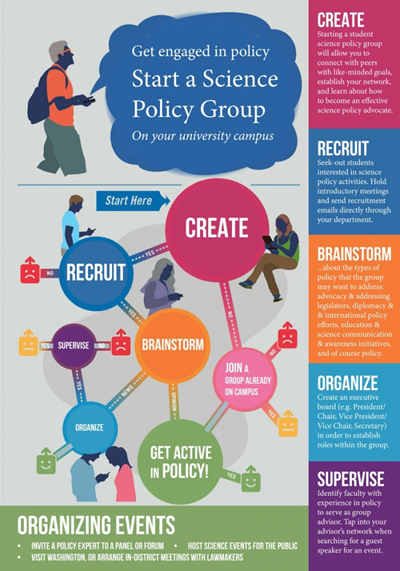
Local engagement - A few ideas on how to get more involved.