
5G Misinformation

Date: May 09, 2026
Category: Public Health
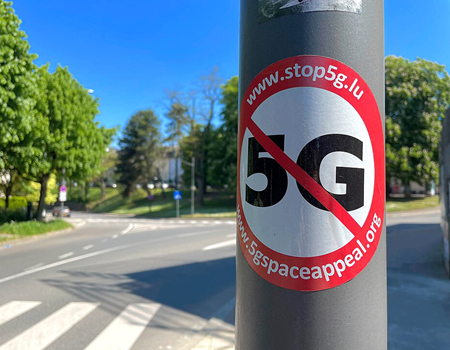
All images are AI generated or shared
under Creative Commons licencing complying with rules for Attribution, Non-Commercial, No Derivatives, and Share Alike.
Image Link
Wikipedia Commons
Creative Commons Attribution-Share Alike 4.0 International license.
2022
Introduction
Every technological leap has its shadow mythology. Radio waves caused cancer. Power lines caused leukemia. WiFi scrambled children's brains. Each wave of fear followed the same pattern: invisible forces, invisible harm, a public poorly equipped to assess electromagnetic science, and a media ecosystem that found anxiety more profitable than accuracy. 5G is simply the latest chapter - but it's a louder, faster, more dangerous one, because this time the mythology arrived before the technology did.
"The 5G story is complete and utter rubbish, it's nonsense, it's the worst kind of fake news."
The core claim circulating across social media platforms, alternative health websites, and conspiracy forums is seductively simple: 5G radiation causes harm (radiophobia) The harm shifts depending on who's telling the story - cancer, neurological damage, immune suppression, or, during the COVID-19 pandemic, the virus itself. In some iterations, 5G towers were being used to "activate" the virus. In others, the vaccines contained microchips that would respond to 5G signals. None of this has any basis in physics, biology, or evidence. All of it spread with terrifying velocity.
The physics matter here. 5G operates on radiofrequency electromagnetic fields - non-ionising radiation. Unlike X-rays or gamma rays, it doesn't carry enough energy to break chemical bonds or damage DNA. The International Commission on Non-Ionizing Radiation Protection, the WHO, and public health agencies worldwide have reviewed the evidence and found no established health risk at exposure levels well above those encountered in daily life. The scientific consensus is not tentative. It is not manufactured. It is the product of decades of research across independent institutions in dozens of countries.
And yet the myth persists - and in 2020 it turned violent. In the United Kingdom, more than 90 mobile phone towers were set on fire. Telecom engineers were assaulted in the street. The arson wasn't random stupidity; it was the predictable endpoint of a disinformation campaign that had been building for years, amplified by YouTube, Facebook, and a constellation of wellness influencers who found that fear of invisible technology converted extremely well to supplement sales.
What makes 5G conspiracy theories such an effective vehicle for anti-science sentiment is their structural flexibility. The theory absorbs new anxieties. During COVID, it absorbed pandemic panic. In anti-government communities, it became a surveillance story. In natural health circles, it became about "electrohypersensitivity" - a self-reported condition for which controlled studies have consistently failed to demonstrate any physiological basis. The conspiracy is modular. You can plug your existing fear into it and it will hold.
This modularity is not accidental. Researchers who study health misinformation have identified a common feature across anti-5G, anti-vaccine, and anti-GMO movements: they don't require you to believe any specific thing, only to distrust institutions. Distrust the WHO. Distrust telecom companies. Distrust the studies, because the studies were funded by the people who want to sell you the technology. Once institutional trust is removed, any counter-evidence becomes proof of conspiracy. The system becomes unfalsifiable, and therefore impervious to correction.
The tragedy is that 5G misinformation has real costs beyond burned towers. It delays infrastructure buildout in communities that don't understand what's being discussed. It drowns local planning meetings in fear-based testimony. It diverts public health attention from actual environmental hazards. And it erodes the epistemic commons - the shared agreement on how we know things - without which democratic decision-making about technology becomes nearly impossible.
The antidote isn't simply "more information." Studies show that myth correction can sometimes backfire, reinforcing false beliefs through the act of repetition. What works better is inoculation: explaining how misinformation is constructed before people encounter it, building resistance to manipulative techniques rather than targeting specific false claims. The 5G myth didn't spread because people are stupid. It spread because it was engineered - by attention economies, by bad actors, and by the very human tendency to find pattern and threat in what we cannot see.
The spread of 5G misinformation is a case study in how anti-science movements weaponise legitimate public uncertainty. The question isn't whether people should ask questions about new technology - they should. The question is whether those questions are answered by evidence or by ideology dressed as evidence. Right now, for 5G, ideology is winning.
View Citations (8)