Bayes' Theorem and the Logic of Science Denial

Date: May 16, 2026
Category: Science General
All images are AI generated or shared
under Creative Commons licencing complying with rules for Attribution, Non-Commercial, No Derivatives, and Share Alike.
Image Link
AI generated
2026
Introduction
To understand why people reject scientific consensus, we might look not to psychology alone, but to mathematics - specifically to a 250-year-old formula that describes how rational minds should update their beliefs when new evidence arrives. Bayes' theorem, at its core, says that your new belief in something should be a function of your prior belief combined with the strength of the incoming evidence. It sounds clinical, almost mechanical. But it illuminates something profound about why antiscience thinking is so persistent, and why simply presenting more evidence so rarely changes minds.
"Critical thinking is an active and ongoing process. It requires that we all think like Bayesians, updating our knowledge as new information comes in."
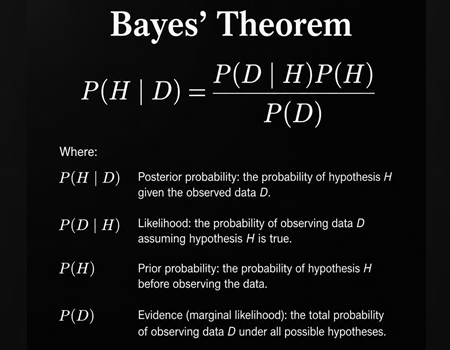
The theorem can be stated simply: the probability you assign to a belief after seeing evidence depends on how probable you thought it was before seeing that evidence, multiplied by how likely that evidence would be if your belief were true. Prior belief, in other words, is not a bias to be eliminated - it is a legitimate input into rational reasoning. The problem is that when priors are extreme, even strong evidence struggles to move them.
Consider a committed vaccine sceptic. Their prior probability that vaccines are safe might be very low - say 5%. When a large randomised controlled trial is published showing high vaccine safety and efficacy, Bayes' theorem tells us how much that evidence should shift their belief. But because their starting point is so far from the evidence, and because they will also heavily discount the likelihood of that evidence being genuine - suspecting, perhaps, that the trial was industry-funded or that regulators are corrupt - the update is minimal. The mathematics reflects the psychology exactly: strong priors resist revision, especially when the incoming evidence is itself subjected to sceptical reinterpretation.
This is where antiscience thinking reveals its Bayesian signature. Denial movements do not simply reject evidence - they systematically manipulate the likelihood term in the equation. If a climate scientist publishes a study confirming warming, the denier's internal calculus assigns very low probability to that study being legitimate, because their worldview includes the premise that climate science is a coordinated hoax. Under those conditions, no single study - or even a thousand studies - can move the needle meaningfully. The maths forces the conclusion: if you believe the evidence is fabricated, evidence cannot update you.
Bayes' theorem also explains the asymmetry between accepting and rejecting scientific consensus. For someone with a prior that vaccines cause autism - a belief seeded by a single fraudulent 1998 paper and amplified by celebrity endorsement - every adverse event following vaccination becomes confirmatory. Their likelihood function is calibrated to find the hypothesis confirmed by almost any outcome. This is not stupidity. It is Bayesian reasoning operating on corrupted inputs.
The therapeutic implication is sobering. If you cannot change someone's prior directly, and if they have already assigned near-zero likelihood to your evidence being genuine, then presenting more evidence is mathematically futile. What must shift first is the prior itself - the foundational belief - and priors change not through data dumps but through trust, identity, and relationship. This is why the most effective antiscience interventions work at the level of values and credibility, not at the level of facts.
Bayes does not excuse science denial. But it explains, with uncomfortable precision, why it endures.
View Citations (6)