Re-emergence of Measles

Date: 2026-04-18
Category: Vaccines
Introduction
For much of the early twenty-first century, measles was widely regarded in the United States as a disease of the past. Declared eliminated in 2000 after decades of high vaccination coverage, it became a symbol of modern public health success. That status is now under serious threat. Over the past two years, the country has experienced one of the most significant measles resurgences in generations, revealing deep fractures in vaccination coverage, public trust, and the nation's disease-prevention infrastructure.
"Misinformation or distrust of vaccines can be like a contagion that can spread as fast as measles."
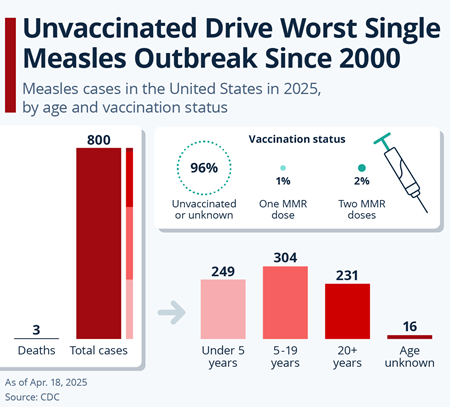
The scale of the resurgence is striking. In 2025, the United States recorded more than 2,200 confirmed measles cases, the highest annual total since the early 1990s, with the vast majority linked to large, sustained outbreaks. That trend has continued into 2026, with more than 1,700 cases reported across over 30 states by early April, placing the country at real risk of losing its measles-elimination status. Nearly all cases have occurred among unvaccinated individuals or those with unknown vaccination status, underscoring a pattern public health experts describe as both predictable and preventable.
Measles is uniquely unforgiving of gaps in immunity. One of the most contagious viruses known, it can remain airborne for up to two hours and spreads rapidly in communities where vaccination rates fall below the herd-immunity threshold of roughly 95 percent. Surveillance studies show that in multiple U.S. regions - particularly parts of Texas, the Southwest, and the rural Southeast - MMR vaccination coverage has dropped well below that level, creating clusters of vulnerability large enough to sustain outbreaks once the virus is introduced.
The re-emergence of measles is inseparable from the broader rise in public resistance to vaccines. While a majority of Americans continue to support vaccination, confidence has become increasingly uneven and polarized. National surveys reveal declining assurance in vaccine safety testing and school vaccination requirements, particularly among certain political and ideological groups. Support for mandatory childhood vaccination policies, including MMR requirements, has eroded markedly compared to levels seen just a decade ago.
This resistance has been fueled by several converging forces. The COVID-19 pandemic disrupted routine immunization programs, normalized skepticism toward public health guidance, and amplified misinformation through social media and alternative media ecosystems. Polling shows that nearly half of U.S. adults report their views on vaccines changed in the past five years, with a significant share becoming more hesitant due to mixed messaging, distrust of institutions, and perceived conflicts among experts. Although many parents still vaccinate their children, growing numbers express doubts about the necessity, safety, or scheduling of routine vaccines, creating precisely the conditions measles exploits.
The consequences extend beyond individual health outcomes. Measles outbreaks strain public health systems, require costly emergency responses, and place vulnerable populations - infants, immunocompromised individuals, and those unable to be vaccinated - at heightened risk. Hospitalizations and deaths have already occurred in recent outbreaks, reversing years of progress against a disease that once caused tens of thousands of U.S. hospitalizations annually before widespread vaccination.
The return of measles is therefore not merely a resurgence of a virus, but a warning signal. It reflects a breakdown in collective protection driven by declining trust, fragmented information, and weakening policy consensus. Public health experts emphasize that reversing this trend will require more than outbreak control. Sustained investment in immunization infrastructure, consistent and credible communication, and renewed commitment to evidence-based vaccination policy are essential if the United States is to prevent measles - and other vaccine-preventable diseases - from reclaiming a permanent foothold.