
Social Media Amplification

Date: May 09, 2026
Category: Antiscience
All images are AI generated or shared
under Creative Commons licencing complying with rules for Attribution, Non-Commercial, No Derivatives, and Share Alike.
Image Link
Wikipedia Commons
Creative Commons Attribution-Share Alike 4.0
2026
Introduction
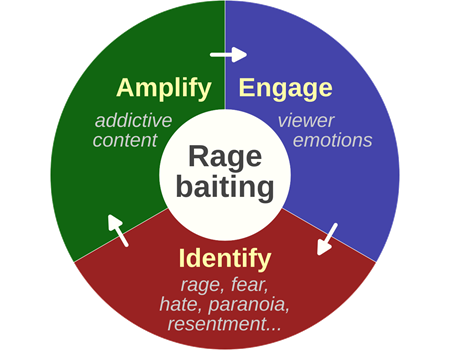
There is nothing accidental about the way misinformation spreads online. It does not drift through social media the way a rumour drifts through a neighbourhood - slowly, imprecisely, losing fidelity with distance. It travels with precision, because the systems that carry it have been engineered to maximise engagement, and engagement, it turns out, is most reliably triggered by content that makes people feel threatened, outraged, or afraid. Anti-science content, which trades in all three, is among the most potent fuels the attention economy has ever found.
"Social media is not media. It's an amplifier."
The core mechanism is recommendation. YouTube's algorithm, Facebook's feed, TikTok's For You page - these are not neutral conduits. They are active curators, shaped by billions of data points about what keeps users watching, scrolling, and returning. Researchers at MIT found that false news spreads faster and further on Twitter than true news, reaching people six times more quickly. The advantage isn't bots. It's novelty and emotional charge - false stories tend to be more surprising and more emotionally provocative than accurate ones, and humans respond to that. Algorithms learn this about us and exploit it remorselessly.
The journey from curiosity to radicalisation is disturbingly short. A person searches for questions about vaccine ingredients and within a few clicks finds themselves in a content ecosystem built entirely on institutional distrust. This is what researchers call the "rabbit hole" effect - each recommendation is slightly more extreme than the last, because slightly more extreme content generates slightly more engagement. The algorithm isn't trying to radicalise anyone. It has no ideology. It is simply optimising for watch time, and the architecture of outrage happens to serve that goal perfectly.
What makes social media amplification particularly corrosive for science is that it systematically inverts the epistemic authority that scientific consensus depends on. On a Facebook group or a Telegram channel, a nurse who read three articles about ivermectin carries the same apparent weight as an epidemiologist with thirty years of peer-reviewed research. Credibility in these spaces is conferred not by expertise but by confidence, charisma, and the willingness to say things that feel transgressive. The person who "asks questions" the mainstream won't ask becomes the authority. The institution that actually answers those questions with data becomes the suspect.
Platform architecture (information silos) reinforces this. Closed Facebook groups and Telegram channels create the social texture of a community - shared language, in-group identity, mutual reinforcement - while insulating members from outside correction. Leaving the group means leaving the community. Accepting counter-evidence means betraying the people you've come to trust. The social cost of changing your mind becomes prohibitively high, which is why debunking campaigns so often fail: they're trying to change beliefs that are now load-bearing parts of someone's social identity.
The solutions being tested - algorithmic demotion of misinformation, content warnings, fact-check labels - have shown modest effects at best. Labels are ignored by people already committed to a belief. Demotion moves content to alternative platforms where it festers without any corrective context at all. What the evidence increasingly suggests is that the only durable intervention is structural: building digital literacy before people encounter the machinery of manipulation, teaching the techniques of misinformation rather than correcting individual claims. The algorithm knows what scares you. The question is whether you know it too.
View Citations (5)