Taxonomy of Antiscience Themes

Date: 2026-04-21
Category: Antiscience
Introduction
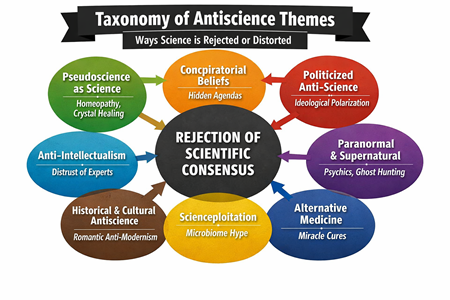
The taxonomy of antiscience themes illustrates how diverse forms of scientific rejection and distortion share common psychological and cultural roots. At its center lies the Rejection of Scientific Consensus, the defining feature of antiscience behavior. This rejection manifests through multiple interconnected pathways - each representing a distinct but overlapping mode of resistance to evidence-based reasoning.
"We're living through a... 'anti-science superstorm,' where a concerted group of global actors, billionaires, leaders of nation-states, and credentialed experts work to confuse and mislead the public."
Pseudoscience Presented as Science occupies one major branch. It includes practices like homeopathy and crystal healing that borrow scientific vocabulary to appear credible while lacking empirical validation. These practices exploit the public's trust in science by mimicking its language and aesthetics without adhering to its methods.
Adjacent to this is Conspiratorial Beliefs, which frame science as a tool of hidden elites or corrupt institutions. Such narratives - claiming that cures are suppressed or data manipulated - transform skepticism into paranoia, eroding trust in legitimate inquiry.
Politicized Anti-Science and Anti-Intellectualism represent cultural and ideological dimensions. Politicized rejection arises when scientific findings threaten identity or ideology, while anti-intellectualism dismisses expertise altogether, equating opinion with evidence. Both feed into the broader erosion of authority that enables pseudoscience to thrive.
Alternative Medicine Over Evidence-Based Care and Scienceploitation highlight the commercial side of antiscience. The former substitutes unproven remedies for medical treatment, while the latter exaggerates preliminary research - such as microbiome or stem-cell hype - to sell products. These exploit emotional needs and market incentives rather than scientific rigor.
Paranormal and Supernatural Claims and Historical & Cultural Antiscience complete the taxonomy. They reflect humanity's enduring fascination with mystery and moral critique of modernity. From ghost hunting to romantic anti-modernism, these themes reject rationalism in favor of intuition or faith.
Together, these categories form a web of interrelated forces that distort public understanding. The diagram's circular design emphasizes that antiscience is not a single ideology but a spectrum of attitudes - commercial, cultural, political, and psychological - all orbiting around the central act of rejecting scientific consensus.