
Chemtrails

Date: September 24, 2026
Category: Public Health
All images are AI generated or shared
under Creative Commons licencing complying with rules for Attribution, Non-Commercial, No Derivatives, and Share Alike.
Image Link
Wikipedia Commons
This work has been released into the public domain by its author, Arpingstone.
2007
Introduction
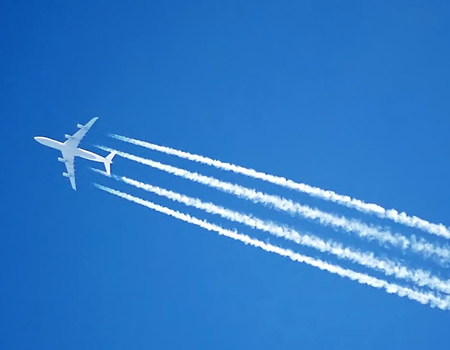
The 'chemtrails' conspiracy theory claims that the persistent trails sometimes visible behind aircraft (contrails) are evidence of chemicals or biological agents being deliberately released into the atmosphere, often for purposes such as population control, weather modification, or other secret government programs. In reality, these visible trails are primarily contrails, formed when water vapor from aircraft exhaust condenses and freezes into ice crystals under suitable atmospheric conditions.
"The experts we surveyed resoundingly rejected contrail photographs and test results as evidence of a large-scale atmospheric conspiracy."
From an anti-science perspective, chemtrail beliefs illustrate how conspiracy thinking can reject established scientific explanations in favor of claims that lack credible supporting evidence. Atmospheric scientists have studied contrails extensively, including their formation, persistence, and potential effects on climate. The chemtrail narrative, by contrast, often relies heavily on visual interpretation, anecdotal observations, selective evidence, and assumptions about secret activities rather than testable evidence demonstrating that aircraft are conducting the alleged spraying.
The risks extend beyond belief in a particular conspiracy theory. Chemtrail narratives can contribute to broader distrust of scientists, governments, aviation authorities, and other institutions responsible for monitoring the atmosphere. They can also reinforce a general rejection of expert knowledge when scientific explanations conflict with preconceived beliefs.
Chemtrails therefore provide an example of how anti-science thinking can operate: an observation that is real - the presence of persistent aircraft trails - is combined with an unsupported explanation for that observation. Scientific inquiry instead asks whether competing explanations can be tested against measurable evidence. When evidence consistently supports atmospheric processes such as contrail formation, rejecting those explanations without comparable evidence illustrates a fundamental departure from scientific reasoning.
The broader danger is that repeated exposure to unsupported scientific claims can weaken public understanding of how evidence is evaluated and how reliable scientific knowledge is established.
View Citations (5)