
Politics of Anti-Intellectualism

Date: April 16, 2026
Category: Science Education
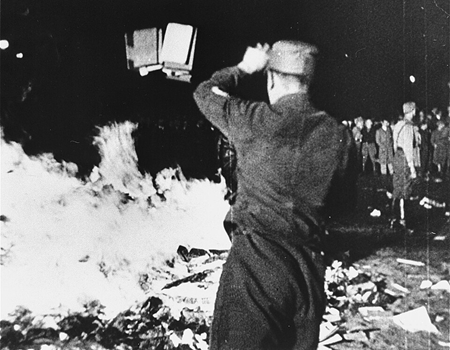
All images are AI generated or shared
under Creative Commons licencing complying with rules for Attribution, Non-Commercial, No Derivatives, and Share Alike.
Image Link
Wikipedia Commons
United States Holocaust Memorial Museum
1933
Introduction
Anti-intellectualism is not a single movement so much as a recurring political mood - one that surfaces whenever expertise, scholarship, or scientific consensus becomes entangled with questions of power. Its politics revolve around who is trusted to define reality. When institutions such as universities, research agencies, or the press are perceived as distant, elitist, or aligned with particular cultural values, skepticism toward them can harden into a broader rejection of expertise itself. This dynamic is not new; historians have traced cycles of anti-intellectual sentiment throughout modern democracies, often emerging during periods of rapid social change when people feel disoriented or unheard.
"Hitler kept the truth from his servile masses. Instead of intellectual persuasion he gave them emotional suggestion."
At its core, anti-intellectualism is political because it shapes how communities decide what counts as legitimate knowledge. Some commentators describe it as a response to inequality - when people feel excluded from decision-making, they may view experts as gatekeepers rather than guides. Others argue that it can be strategically amplified: framing expertise as suspect can mobilize supporters, simplify complex issues, or create an "us versus them" narrative. In these contexts, rejecting intellectual authority becomes a way to assert identity and autonomy, even when the issues at stake - public health, education, climate, technology - are deeply technical.
The politics of anti-intellectualism also thrive in environments where information is abundant but trust is scarce. Digital platforms allow communities to form around shared beliefs rather than shared evidence, and this can elevate personal intuition or anecdote over systematic inquiry. Some researchers note that this shift does not necessarily reflect hostility toward knowledge itself, but toward the institutions that traditionally produce and validate it. When people feel that experts do not listen to their lived experience, they may turn to alternative sources that feel more aligned with their values, even if those sources lack rigor.
Yet anti-intellectualism is not simply a rejection of learning; it is a struggle over whose knowledge matters. Its political impact becomes most visible when it influences public policy - shaping debates on science education, public health guidance, or the role of research in government decision-making. In these moments, the tension between expertise and populist sentiment becomes a defining feature of democratic life. Understanding this dynamic requires more than lamenting the decline of trust; it requires examining how institutions communicate, how communities feel represented, and how societies negotiate the balance between expert authority and democratic participation.
View Citations (6)