
The Exodus of Scientists from the United States

Date: October 31, 2026
Category: Antiscience
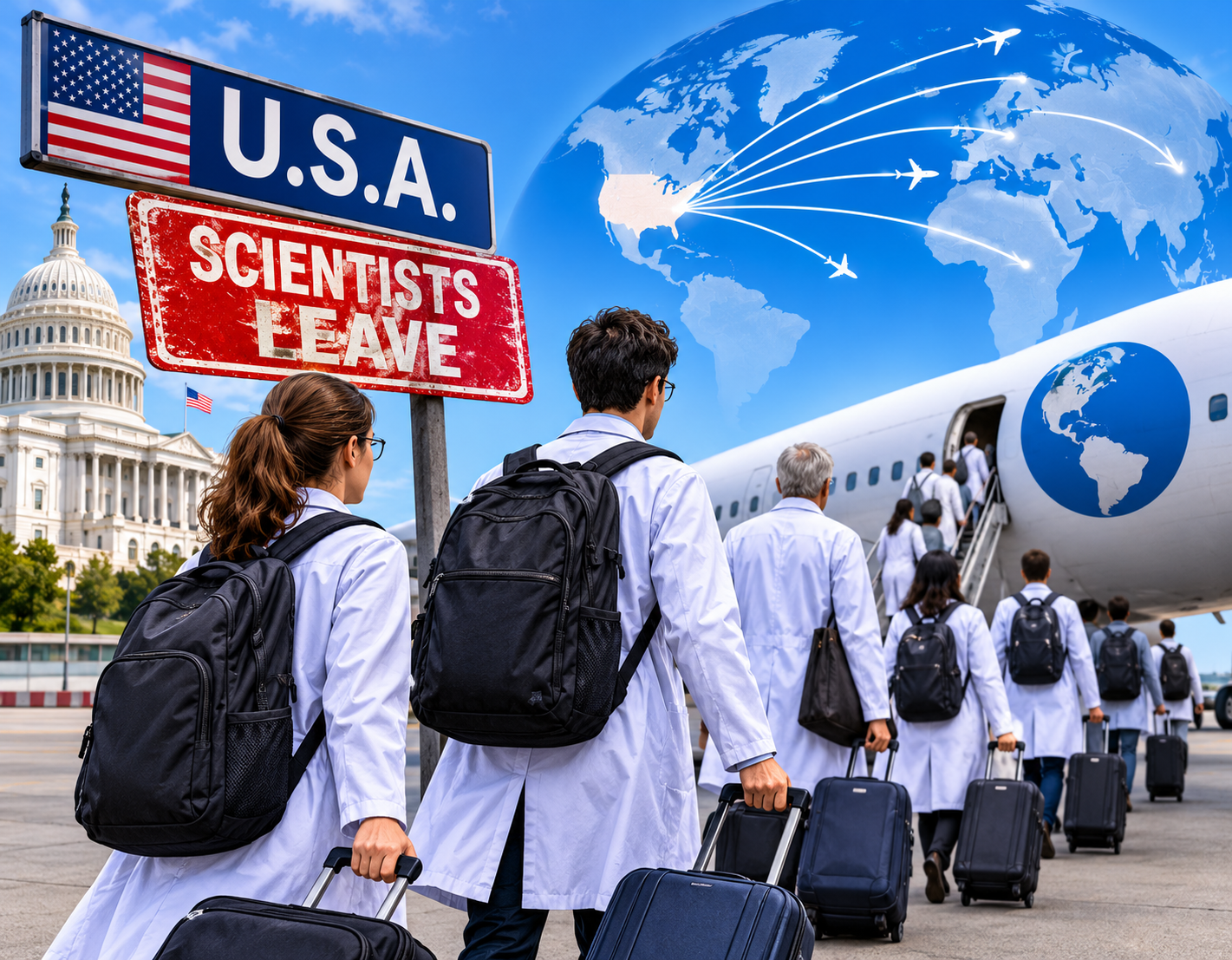
All images are AI generated or shared
under Creative Commons licencing complying with rules for Attribution, Non-Commercial, No Derivatives, and Share Alike.
Image Link
Introduction
The United States has long been regarded as the world's leading destination for scientific talent, research investment, and technological innovation. Its universities, government laboratories, and research institutions attracted exceptional scientists from around the globe. However, this reputation is increasingly threatened by a growing exodus of researchers seeking opportunities elsewhere. From an anti-science perspective, this departure represents one of the most damaging consequences of the politicization of science and the growing disregard for independent scientific inquiry.
"I would really love to be in a place where the type of work that I'm doing is being valued."
The problem has intensified following changes in federal science policy, including substantial research funding reductions, cancelled grants, restrictions on scientific programs, and increased political interference in research priorities. Agencies such as the National Institutes of Health (NIH), National Science Foundation (NSF), and National Oceanic and Atmospheric Administration (NOAA) have experienced significant disruption. Researchers working in climate science, public health, environmental protection, and other politically contentious fields have particular reasons for concern. When scientific investigations become subject to political approval rather than evidence-based evaluation, the independence essential to credible research is undermined.
The consequences are already becoming visible. Researchers are accepting positions in Canada, the United Kingdom, Finland, Australia, and throughout Europe. International universities are actively recruiting American scientists, offering more predictable research funding and greater academic freedom. An earlier Nature survey found that approximately 75 percent of responding American scientists were considering leaving the country. More recent reporting documents researchers who have actually relocated, taking their expertise, research programs, and future discoveries with them.
This brain drain threatens much more than America's international scientific reputation. Research laboratories depend on experienced scientists to mentor graduate students, train emerging researchers, and maintain long-term investigations. When established researchers depart, their students, research teams, institutional knowledge, and sometimes entire research programs can disappear. The consequences may extend for decades, particularly in medicine, biotechnology, climate research, and technological development.
Perhaps most troubling is the message this sends to young scientists and international students. Why pursue a research career in a country where funding is unpredictable, academic independence is questioned, and scientific conclusions may become politically inconvenient? Other nations stand ready to welcome this talent, strengthen their research institutions, and benefit from American scientific investment.
The departure of scientists is a warning sign of a broader institutional failure. Science advances through evidence, skepticism, experimentation, and open debate—not political loyalty or ideological conformity. Undermining those principles risks surrendering America's scientific leadership and weakening humanity's collective ability to address its greatest challenges.
View Citations (12)