
Anti-Science Beyond the United States

Date: November 17, 2026
Category: Antiscience
All images are AI generated or shared
under Creative Commons licencing complying with rules for Attribution, Non-Commercial, No Derivatives, and Share Alike.
Image Link
Introduction
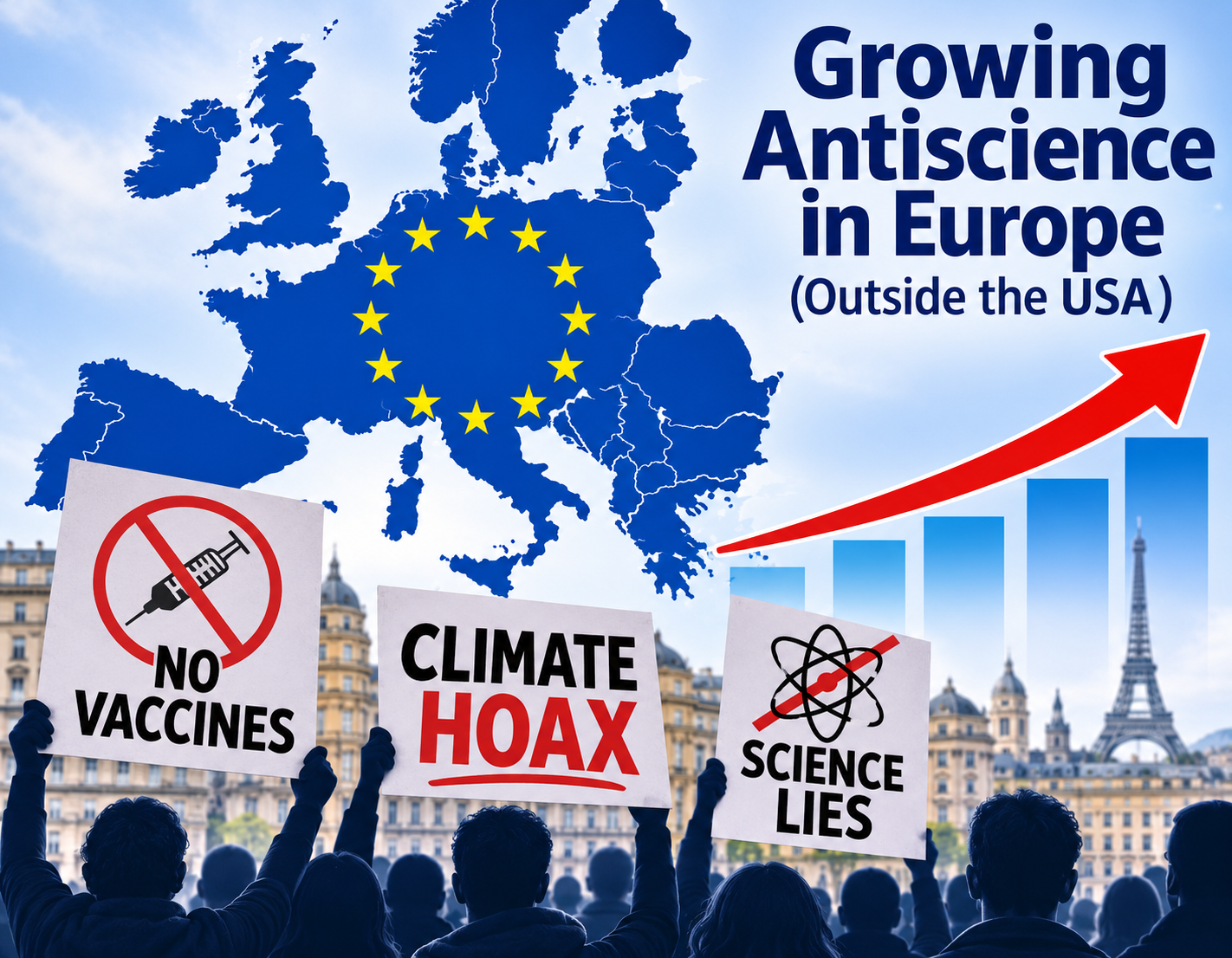
Anti-science movements are no longer confined to the United States, nor are they limited to opposition to vaccines and COVID-19 policies. Across Eastern Europe, journalists, researchers, and fact-checking organizations have documented a growing ecosystem of science disinformation extending into climate change, environmental protection, medicine, energy policy, and public health. What was once largely associated with pandemic-related conspiracy theories has evolved into a broader rejection of scientific evidence, expertise, and institutional credibility.
"Our world is fast succumbing to the activities of men and women who would stake the future of our species on beliefs that should not survive an elementary school education."
Beyond Vaccines - An Expanding Disinformation Landscape: In Poland, medical misinformation has expanded well beyond traditional anti-vaccination campaigns. False claims now target cancer treatments, medical screening, organ transplantation, abortion, and infectious diseases, including tuberculosis and whooping cough. Conspiracy narratives suggest that effective cancer treatments are deliberately concealed by pharmaceutical companies, while unproven alternative remedies are promoted as legitimate medical solutions. Similar campaigns undermine confidence in public health institutions and portray established medical advice as commercially or politically motivated.
Climate Science and Environmental Denial: Across Southeast Europe, including Serbia, Croatia, Bosnia and Herzegovina, and Montenegro, climate disinformation has become increasingly prominent. False narratives portray climate change as fabricated, question the scientific evidence behind global warming, and depict renewable energy policies and the European Green Deal as schemes for government control or economic destruction. Conspiracy theories involving weather manipulation, HAARP, geoengineering, and so-called climate lockdowns further undermine public understanding of environmental science.
Political Influence and the Erosion of Scientific Trust: These campaigns frequently intersect with political extremism, nationalist movements, and Russian-backed disinformation operations. Scientific issues become instruments for broader political objectives: weakening confidence in democratic institutions, discrediting Western organizations, and portraying scientific consensus as an ideological agenda. Social media platforms, particularly Telegram and other alternative information networks, help circulate these narratives across national borders.
A Global Warning: Although the United States has developed its own highly visible political anti-science movement, Eastern Europe's experience demonstrates that science denial is an international phenomenon with locally adapted messages and motivations. The underlying strategy is remarkably consistent: undermine scientific institutions, manufacture doubt, elevate conspiracy theories, and replace evidence with ideological conviction. The consequences extend beyond misinformation itself, threatening public health, environmental protection, informed policymaking, and society's ability to respond collectively to complex scientific challenges. Science denial is not simply disagreement with individual discoveries; it is an increasingly organized challenge to the authority of scientific knowledge itself.