
Defunding the NOAA

Date: October 26, 2026
Category: Antiscience
All images are AI generated or shared
under Creative Commons licencing complying with rules for Attribution, Non-Commercial, No Derivatives, and Share Alike.
Image Link
Creative Commons Attribution-ShareAlike 4.0 International (CC BY-SA 4.0)
2025
Introduction
The dismantling of public climate science infrastructure represents a significant example of how political interference and anti-science ideology can undermine scientific institutions, weaken public understanding, and increase societal vulnerability to environmental risks. When governments marginalize scientific expertise, restrict access to research, and weaken institutions responsible for communicating evidence-based findings, the consequences extend far beyond the scientific community.
"I suspect we haven't seen the worst outcomes from the loss of capacity yet. You can't pick up that kind of slack."
The downsizing and defunding of the National Oceanic and Atmospheric Administration (NOAA) under the Trump administration led to the loss of scientific personnel, research capacity, and public information services, including the closure of the widely used Climate.gov website in 2025. For years, Climate.gov served as an important public resource, translating complex climate research into accessible information about global warming, historical climate trends, extreme weather, and environmental risks. Its disappearance removed a valuable connection between government scientists and the public.
The consequences extend beyond public education. NOAA's broader workforce reductions have also affected research and operational capabilities involving hurricane forecasting, atmospheric modeling, satellite observations, and environmental monitoring. These programs provide essential information for tracking extreme weather, anticipating hazards, and protecting communities. While the closure of Climate.gov did not itself eliminate NOAA's weather forecasting systems, the simultaneous reduction of scientific personnel and research capacity threatens the expertise and infrastructure needed to maintain reliable environmental monitoring and communicate emerging risks. Making climate information harder to find, interpret, or independently verify also creates opportunities for misinformation, climate denial, and politically motivated distortions of scientific evidence.
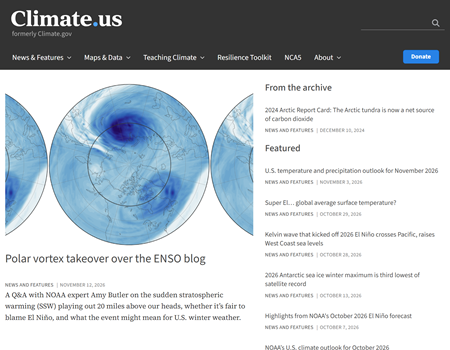
The response to these actions demonstrates the resilience of the scientific community. Former NOAA employees, including scientists and the former Climate.gov editorial team, established Climate.us, an independent nonprofit successor launched in June 2026. Led by former program manager for the NOAA.gov website, Rebecca Lindsey, the initiative seeks to restore public access to reliable climate information, preserve historical climate records and modeling resources, and rebuild educational tools that explain climate science. Supported by nonprofit partners, donors, and volunteer scientists, Climate.us is working to protect scientific information from political interference and ensure that educators, researchers, journalists, and the public retain access to credible climate resources.
Ultimately, the dismantling of Climate.gov illustrates a fundamental characteristic of anti-science movements: undermining the institutions that produce, communicate, and defend scientific knowledge. When governments weaken scientific agencies, dismiss experts, and make evidence-based information less accessible, the consequences extend well beyond research communities. Public safety, informed decision-making, climate preparedness, and democratic accountability are all put at risk. The emergence of Climate.us is therefore more than a replacement website; it is an effort to defend the principle that scientific knowledge belongs in the public domain, not at the mercy of political ideology.
Updates
2026-11-16: Several of the most sweeping proposed budget cuts and programmatic changes targeting the NOAA have been actively prevented or reversed by Congress. For example, the U.S. Senate has passed the bipartisan "Weather Act," sending it to the House for consideration. The bill would authorize programs at the National Oceanic and Atmospheric Administration (NOAA) with a goal of strengthening weather research and forecasting to save lives and better prepare for dangerous weather.