
Climate Change Funding

Date: November 25, 2026
Category: Antiscience
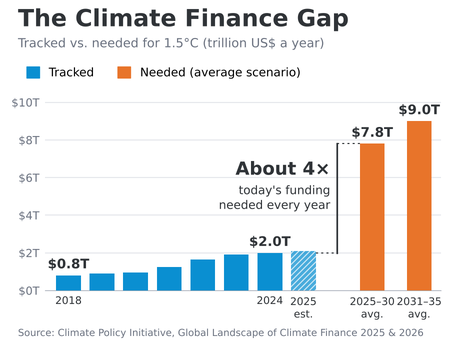
All images are AI generated or shared
under Creative Commons licencing complying with rules for Attribution, Non-Commercial, No Derivatives, and Share Alike.
Image Link
AI Geneated based on Climate Policy Initiative projections.
2026
Introduction
Addressing climate change requires substantial financial investment, but the effectiveness of that funding depends on more than simply how much money is available. Governments, philanthropic organizations, financial institutions, and private investors play an increasingly important role in accelerating climate solutions. However, funding decisions must be guided by scientific evidence, strategic priorities, and measurable outcomes rather than political agendas, popular narratives, or short-term interests. Without a science-driven approach, even substantial financial resources can be misdirected, delaying meaningful climate action.3,4
"Climate finance is not charity, it's an investment. Climate action is not optional, it's an imperative. Both are indispensable to a liveable world for all humanity and a prosperous future for every nation on Earth"
In a November 2026 article, How Climate Funders Can Step Boldly into a New Era of Science-Driven Action, Project Drawdown's Lauren Gifford1 argues that climate funding needs to shift from simply providing more capital toward deploying existing resources more strategically. She introduces the concept of precision capital deployment, in which scientific research helps determine which climate solutions offer the greatest potential, where they will be most effective, and when investment can produce the greatest benefits.2 Similar to precision agriculture,5 which uses data to determine where resources are most needed, climate funding should reflect regional conditions, emissions-reduction potential, and the practical barriers to implementation.
This approach recognizes that climate solutions do not deliver equal results everywhere. Electric heat pumps, for example, offer significant emissions reductions, but their effectiveness depends on local temperatures, electricity sources, and the heating systems they replace.6,7,8 Funding decisions must also consider broader benefits, including improved public health, economic opportunity, biodiversity, and community resilience. Equally important is identifying where investment can remove obstacles, whether through additional scientific research, infrastructure development, workforce training, or supportive public policy.
From an anti-science perspective, the consequences of poorly directed climate funding are particularly concerning. Political interference, ideological opposition, fossil-fuel lobbying, and misinformation9,10 can undermine scientific priorities and divert resources away from effective solutions. Defunding climate research and scientific institutions11,12,13 further weakens the evidence needed to make informed investment decisions. Meanwhile, delaying proven interventions increases the eventual economic, environmental, and social costs of climate change.14,15,16
Climate funding must be both ambitious and accountable.17 As Project Drawdown emphasizes, science should inform investment decisions while incorporating equity, environmental justice, and community leadership. Funding should be continuously evaluated and adjusted as new evidence emerges. Investing in climate solutions is not simply about spending more money; it is about ensuring that every dollar advances measurable, science-based progress.