
Climate Change Models

Date: November 08, 2026
Category: Climate Change
All images are AI generated or shared
under Creative Commons licencing complying with rules for Attribution, Non-Commercial, No Derivatives, and Share Alike.
Image Link
Introduction
Climate change models are sophisticated computer simulations used by scientists to understand how Earth's climate system works and predict how it may change in the future. They are among the most important tools in climate science, helping researchers evaluate the consequences of greenhouse gas emissions, rising global temperatures, and potential changes in weather patterns. Although often described as predictions, climate models are more accurately understood as projections based on different assumptions about future human activities and greenhouse gas emissions.
"The hockey stick did not suddenly appear out of left field. Rather, it arose as a logical consequence of decades of work by paleoclimate researchers that led to increasingly rich networks of climate proxy data..."
How Climate Models Work: Climate models divide the Earth into a three-dimensional grid representing the atmosphere, oceans, land surfaces, and ice. Using mathematical equations based on established physical laws, they simulate how energy, heat, moisture, and gases move through these interconnected systems. Models incorporate variables such as solar radiation, greenhouse gas concentrations, cloud formation, ocean circulation, volcanic activity, and land-use changes. Scientists then run simulations using different emissions scenarios to explore possible climate outcomes over decades or centuries.
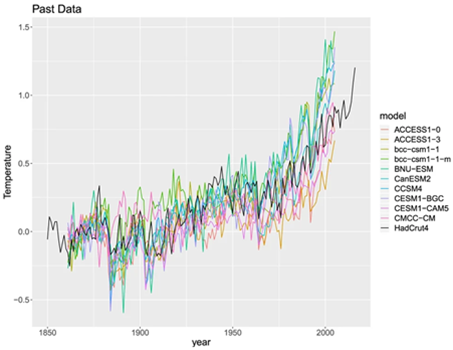
Accuracy and Reliability: Climate models are not perfect, but their reliability has improved considerably over the past several decades. Scientists evaluate their accuracy by comparing historical model projections with actual observed temperatures and other climate measurements. Many earlier models have successfully anticipated the overall warming trend, even when their projections differed slightly from subsequent observations. Models are particularly reliable at projecting long-term global temperature increases, although regional precipitation, cloud behavior, and extreme weather patterns remain more difficult to simulate precisely.
Limitations and Uncertainty: Uncertainty does not mean climate models are unreliable. It reflects the complexity of Earth's climate system and the difficulty of anticipating future human behavior. Different assumptions about population growth, energy consumption, technology, and emissions produce different projections. Models also simplify certain processes, particularly cloud formation and interactions between the atmosphere and oceans. Consequently, projections are generally presented as ranges rather than exact future temperatures.
Why Climate Models Matter: Climate models provide essential scientific evidence for understanding global warming and developing effective climate policies. They allow scientists to examine potential futures, assess risks, and evaluate the consequences of delaying emissions reductions. While no model can predict precisely what will happen, their consistent findings provide compelling evidence that continued greenhouse gas emissions will produce significant additional warming. Rejecting climate models because they contain uncertainty misunderstands both their purpose and the scientific method.