Economics of Renewable Energy

Date: 2026-05-18
Category: Climate Change
Introduction
The belief that renewable energy is inherently more expensive than fossil fuels is a myth that persists largely because it lags behind current data. In reality, the economics of energy have shifted dramatically over the past decade, and renewables - especially solar and wind - are now among the cheapest sources of electricity worldwide. This shift is not speculative or aspirational; it is documented across global energy markets and confirmed by major international agencies.
"Renewable energy is proven technology, the price is dropping, the rest of the world is going that way, that's where our investment should be going as well."
The Origins of the "Expensive Renewables" Myth
For much of the 20th century, fossil fuels dominated global energy systems, benefiting from mature infrastructure, entrenched subsidies, and economies of scale. Early renewable technologies, by contrast, were small-scale, experimental, and costly. These early price tags hardened into a narrative: clean energy was a luxury, not a practical alternative. But this narrative froze in time. As renewable technologies improved, scaled, and globalized, their costs plummeted - yet public perception often failed to keep up. The myth survived even as the economics changed beneath it.
What the Data Shows Today
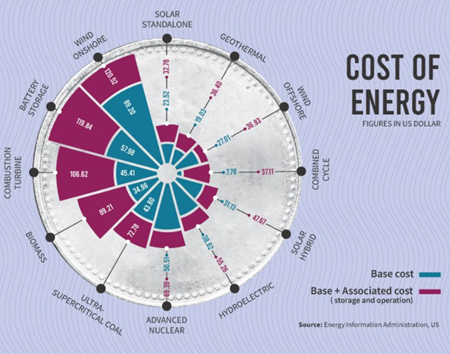
Modern cost analyses consistently demonstrate that renewables are not only competitive with fossil fuels - they are often cheaper. A 2023 report from the International Renewable Energy Agency (IRENA) found that 86% of all newly commissioned renewable capacity in 2022 produced electricity at lower costs than fossil-fuel generation. These savings were not marginal: the global power sector saved USD 520 billion in fuel costs in 2022 alone thanks to renewables. This trend holds across regions. Even in non-OECD countries - where energy transitions are often assumed to be more difficult - new renewable installations are projected to reduce lifetime electricity costs by up to USD 580 billion.
Independent analyses echo this conclusion. One 2025 cost review found that renewable energy is now cheaper than fossil fuels in 81% of cases, reflecting both falling technology costs and rising fossil-fuel volatility.
Why Renewables Are Cheaper
Several structural factors explain this shift:
- No fuel costs. Wind and sunlight are free, insulating renewables from the price shocks that routinely destabilize fossil-fuel markets.
- Rapid technological improvement. Solar module prices have fallen more than 90% since 2010; wind turbines have grown more efficient and durable.
- Economies of scale. As deployment accelerates, manufacturing and installation costs drop.
- Avoided externalities. Renewables reduce air pollution and carbon emissions, avoiding health and climate costs that fossil fuels impose on society.
Why the Myth Persists
Despite overwhelming evidence, the "expensive renewables" myth endures because it aligns with outdated assumptions, political narratives, and the interests of fossil-fuel industries. Some analyses also fail to account for hidden fossil-fuel subsidies or the long-term economic risks of climate change. As a result, public understanding often lags behind the economic reality.
A Changing Energy Landscape
The global energy transition is no longer driven only by environmental urgency - it is propelled by economics. As IRENA notes, 2022 marked a "turning point" in renewable deployment, with cost-competitiveness reaching unprecedented levels even amid inflation and supply-chain pressures.
The myth that renewables are more expensive than fossil fuels is not just outdated - it is the opposite of what today's data shows. Renewables are now a cornerstone of affordable, resilient, and future-proof energy systems.