Growing Illiteracy in the United States

Date: 2026-04-28
Category: Science Literacy
Introduction
The United States is facing a quiet but escalating literacy crisis - one that threatens economic stability, democratic participation, and the long-term health of communities. While the country once prided itself on near-universal literacy, recent national assessments reveal a troubling decline in reading proficiency across both children and adults.
"There are worse crimes than burning books. One of them is not reading them."
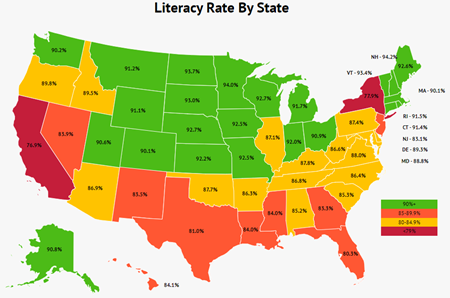
The latest Program for the International Assessment of Adult Competencies (PIAAC) shows that 79% of adults demonstrate medium to high literacy skills, but the remaining 21% - representing roughly 43 million Americans - struggle with basic reading tasks, such as understanding medication labels or completing job applications. This is not a marginal issue; it is a structural one.
The decline is not limited to adults. Early-grade reading performance, a strong predictor of future academic and economic outcomes, is also slipping. Thirty-four percent of U.S. fourth-grade students lack basic reading proficiency, signaling that the next generation is entering adolescence and adulthood without foundational literacy skills. When children fall behind in reading by the fourth grade, research consistently shows they are far more likely to struggle academically, drop out of school, and face limited employment opportunities later in life.
Adult literacy data paints an even more sobering picture. According to recent analyses, more than half of U.S. adults read below a sixth-grade level, and 28% score at or below Level 1 literacy, meaning they have significant difficulty completing everyday reading tasks. These challenges are not merely academic - they shape the ability to navigate healthcare systems, understand legal documents, manage finances, and participate fully in civic life. Low literacy is also closely tied to economic vulnerability. Estimates suggest that the U.S. economy loses up to $2.2 trillion annually due to reduced productivity, lower earnings, and increased healthcare costs associated with low literacy.
The distribution of literacy skills is also shifting. National assessments show a 12-point decline in average literacy scores between 2017 and 2023, with more Americans clustering at the lowest proficiency levels. This "dwindling middle" suggests that the nation is not only failing to lift struggling readers but also losing ground among those who once occupied the middle tiers of proficiency.
Demographic patterns further complicate the landscape. Thirty-four percent of adults with low literacy were born outside the United States, reflecting the need for stronger language-learning support and more accessible adult education programs. Yet even among U.S.-born adults, literacy challenges remain widespread, cutting across regions, socioeconomic groups, and educational backgrounds.
The growing risk of illiteracy is not simply an educational problem - it is a societal one. A population unable to critically evaluate information is more vulnerable to misinformation, less able to participate in democratic processes, and more likely to face economic hardship. Addressing this crisis requires sustained investment in early-childhood education, adult literacy programs, community-based learning initiatives, and policies that recognize literacy as a cornerstone of national well-being.
Without decisive action, the United States risks entrenching a cycle in which millions are left behind - economically, socially, and civically - because they were never given the tools to read, understand, and fully participate in the world around them.