
Importance of Validating Scientific Citations

Date: November 10, 2026
Category: Science Misinformation
All images are AI generated or shared
under Creative Commons licencing complying with rules for Attribution, Non-Commercial, No Derivatives, and Share Alike.
Image Link
AI Generated
2026
Introduction
Scientific citations are essential to the credibility, transparency and reliability of research papers, academic publications and science-related articles. They allow readers to trace claims to their original sources, examine supporting evidence and independently evaluate conclusions. However, citations are not automatically reliable simply because they appear in an academic paper or are accompanied by the name of a respected scientific journal. Checking and validating references is an important part of scientific literacy and protecting the integrity of scientific information.
"The lowest form of popular culture - lack of information, misinformation, disinformation and a contempt for the truth or the reality of most people's lives - has overrun real journalism. "
One common problem is the use of inaccurate, misleading or irrelevant citations. Authors may reference studies that do not actually support their claims, misrepresent research findings or selectively quote evidence that reinforces a predetermined conclusion. In other cases, cited research may be outdated, poorly designed, subsequently corrected or retracted because of scientific misconduct. References can also lead to secondary sources that repeat an original claim without independently verifying it. These practices can create an appearance of scientific credibility where the underlying evidence is weak or nonexistent.
The implications are particularly serious from an anti-science perspective. Science denialists frequently exploit questionable citations to manufacture doubt, promote pseudoscience and challenge established scientific consensus. A single flawed study may be repeatedly referenced across websites, articles and social media until its conclusions appear to have widespread scientific support. This creates an illusion of independent confirmation when multiple publications may ultimately rely on the same questionable source. Fake experts, cherry-picked research and misrepresented scientific findings can further amplify this problem.
Artificial intelligence introduces additional concerns. AI-generated articles and research summaries can contain fabricated references, incorrect publication details or citations to studies that do not support the accompanying claims. Readers who accept these references without verification risk unknowingly spreading misinformation.
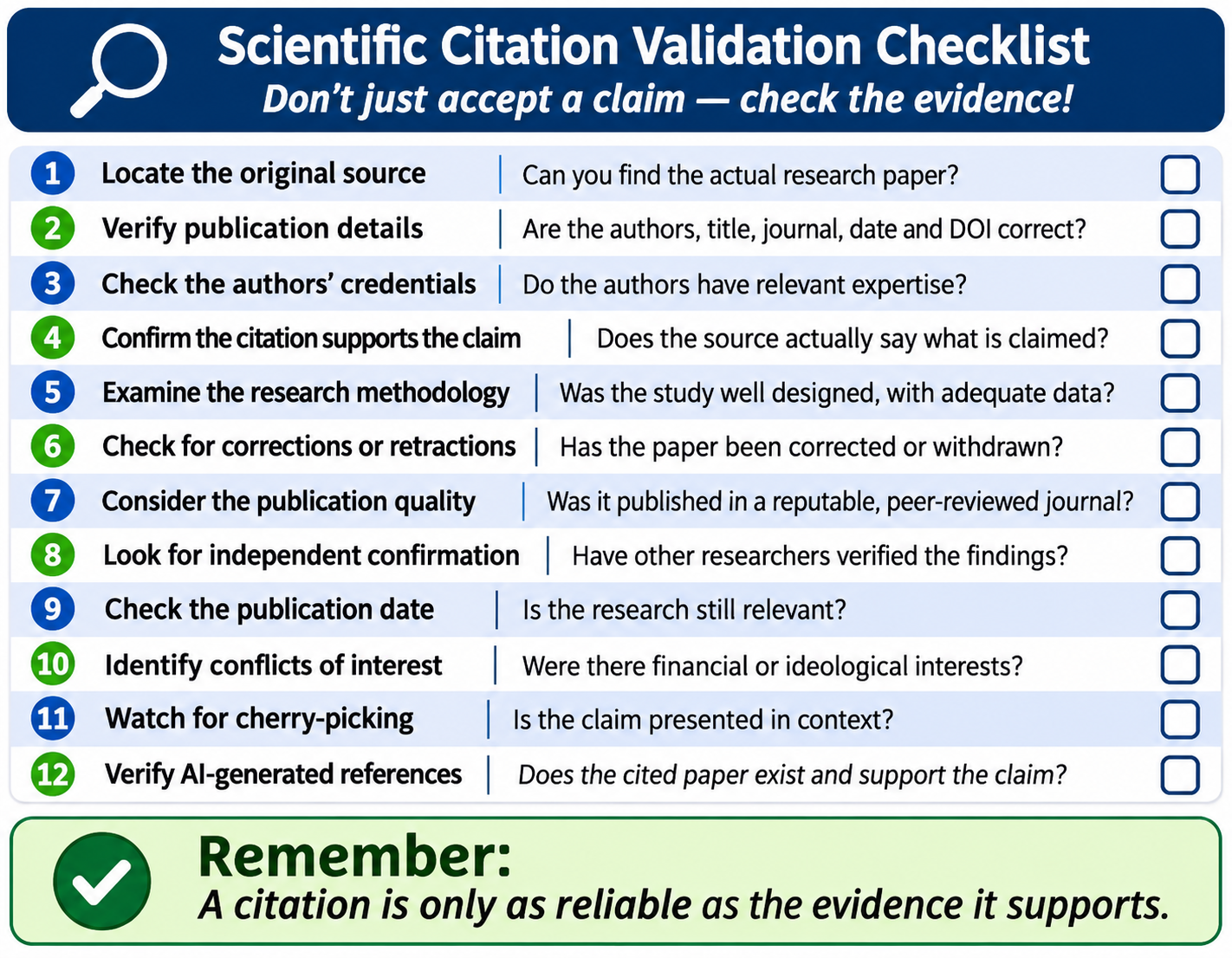
Validating citations involves locating the original publication, confirming its authorship and publication details, examining its methodology and determining whether its findings genuinely support the associated claim. Readers should also check for corrections, expressions of concern and retractions.
Ultimately, citations should never be accepted as proof simply because they are present. Scientific credibility depends on the quality of the underlying evidence, not the number of references supporting an argument. Developing the habit of checking citations is an essential defense against scientific misinformation, intellectual manipulation and the deliberate misuse of scientific research.