
Next Generation Science Standards (NGSS)

Date: November 10, 2026
Category: Science Education
All images are AI generated or shared
under Creative Commons licencing complying with rules for Attribution, Non-Commercial, No Derivatives, and Share Alike.
Image Link
Introduction
The Next Generation Science Standards (NGSS) represent a significant effort to improve science education in the United States by changing not only what students learn, but how they learn to think about science. Developed through collaboration among states, educators and scientific organizations, NGSS emphasizes scientific understanding, critical thinking, experimentation and evidence-based reasoning. Its central goal is to develop scientifically literate students who understand how scientific knowledge is established and applied to real-world problems.
"Students are DOING science and engineering as scientists and engineers do... "
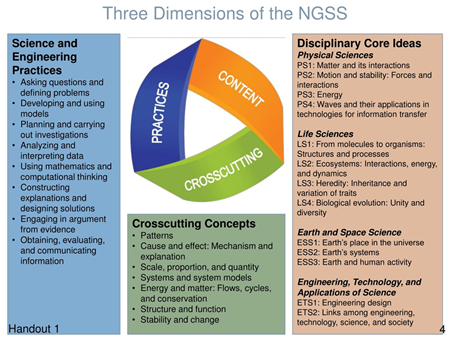
NGSS organizes science education around three interconnected dimensions: scientific and engineering practices, disciplinary core ideas, and crosscutting concepts. Students are encouraged to ask questions, develop hypotheses, conduct investigations, analyze data, construct explanations and defend conclusions using evidence. Rather than simply memorizing scientific facts, they learn how scientific discoveries are made, evaluated and refined. The curriculum covers biology, chemistry, physics, earth and space sciences, while incorporating engineering and practical applications.
These objectives have important implications for combating anti-science. Science denial frequently relies on misleading arguments, selective evidence, conspiracy theories, unqualified experts and the deliberate misrepresentation of scientific uncertainty. By teaching students to evaluate evidence, recognize credible sources and understand how scientific consensus develops, NGSS provides tools to challenge these tactics. Students also learn that scientific conclusions can change as new evidence emerges, without this undermining the reliability of established scientific knowledge.
However, NGSS is not specifically an anti-misinformation curriculum. Its effectiveness depends heavily on implementation, teacher preparation and the availability of appropriate educational resources. Furthermore, scientific knowledge and critical thinking alone do not necessarily prevent individuals from accepting misinformation, particularly when political beliefs, ideological influences and social media reinforce existing misconceptions.
NGSS therefore represents an important foundation for strengthening public scientific literacy, but it should be supplemented with explicit instruction in misinformation, pseudoscience, logical fallacies and the manipulation of scientific evidence. Ultimately, science education must accomplish more than teaching students established scientific facts. It must equip them to evaluate competing claims, recognize unreliable information and make informed decisions based on evidence. Developing these abilities is essential to building a society that values scientific integrity and is better prepared to resist the growing influence of anti-science thinking.