
OpenAlex: Checking the Evidence for Yourself

Date: November 25, 2026
Category: Public Trust
All images are AI generated or shared
under Creative Commons licencing complying with rules for Attribution, Non-Commercial, No Derivatives, and Share Alike.
Image Link
Wikipedia Commons - Creative Commons Attribution 4.0 International license.
2022
Introduction
"A study proves it" It is one of the most common moves in science denial: a single paper, often obscure, flawed or misread, held up as if it overturned decades of research. Most people have no easy way to check. Major research databases such as Scopus and Web of Science sit behind expensive subscriptions,1 and many journal articles are paywalled. Where evidence is hard to reach, a cherry-picked claim can go unchallenged.
"The OpenAlex dataset was a game changer....an open dataset that allows for transparency is essential."
Part of the answer is open accessOpen access is a publishing model and movement that makes research and digital information - such as academic articles, books, and data - freely available online with minimal copyright or licensing barriers. (OA): the movement to make research free to read online, with no subscription or paywall.2 Its purpose is simple. Most research is paid for by the public, through taxes and charitable funding, so the public should be able to read it. Openness also speeds up science and lets anyone, from a nurse to a voter, check what researchers actually found. OpenAlex grew out of this movement. The nonprofit behind it first built Unpaywall, a tool that finds free, legal copies of paywalled papers,3,8 and then set out to open the catalogue of research itself.
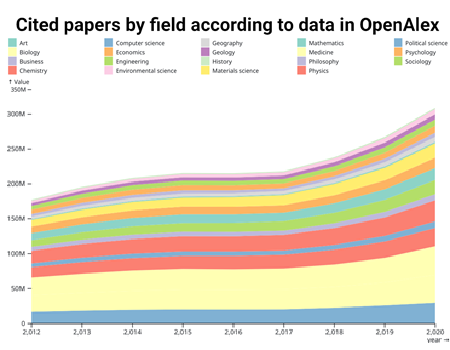
The original Library of Alexandria aimed to collect all scholarly knowledge, and OpenAlex means to carry that spirit forward in the digital age; its name is a nod to that library.4 It started operating in January 2022 as a successor to the terminated Microsoft Academic Graph.5 Today it links hundreds of millions of research outputs, including journal articles, books, datasets, theses and preprints, to their authors, universities, journals, publishers, funders and topics.7 Anyone can search it on the website. Researchers can analyze it at scale through its API and downloadable data, which is released under a CC0 licence,6 so it is free to reuse. Records are gathered and standardized from Crossref, PubMed, ORCID, university repositories and other scholarly services.9
For anyone confronting antiscience, this changes what is possible. A journalist can trace a viral claim back to the paper it supposedly comes from, and see whether that paper stands alone or sits within a large body of research pointing the other way. A teacher can show students how a scientific question develops over time, one citation at a time. A policymaker can find genuine experts on a topic rather than the loudest voices. Its broad international coverage also brings forward research from regions and institutions that are often overlooked.
But OpenAlex is not a truth detector. Being listed does not make a study sound, peer-reviewed, replicated or part of the scientific consensus; retracted papers, predatory-journal articles and weak research are catalogued too.13,14 OpenAlex also has weaknesses of its own as a database. Because it assembles records automatically from many sources, some entries are incomplete or wrong: missing abstracts, duplicate works, authors confused with others who share their name, or papers linked to the wrong institution.11,12 Its coverage and accuracy vary by field, language and region,10 and it is still being improved. Citation counts measure attention, not accuracy: a paper can be widely cited because it is wrong. Users still need to weigh study design, methods, conflicts of interest, the publication venue, corrections and the wider evidence.
That is its real value against antiscience. It does not tell anyone what to believe; it lowers the cost of checking. When anyone can look up the research behind a claim, “a study proves it” becomes something that can be verified, instead of an argument-ender.