Risks and Consequences of Antiscience

Date: 2026-01-25
Category: Antiscience
Introduction
Antiscience rarely arrives with a dramatic flourish. It seeps in quietly - through doubt disguised as "just asking questions," through influencers who value virality over accuracy, through institutions that find it easier to appease than to confront. Yet its consequences are anything but quiet. Antiscience reshapes societies, not by offering a competing vision of the world, but by eroding the very tools we use to understand it.
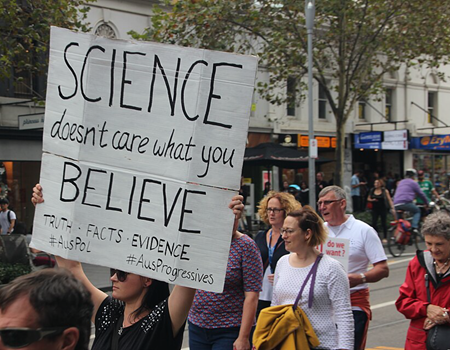
"The good thing about science is that it's true whether or not you believe in it."
At its core, antiscience thrives on a simple but powerful tactic: replacing evidence with emotion. When scientific consensus is reframed as "elitist opinion," expertise becomes suspect, and the door opens for misinformation to fill the vacuum. This shift doesn't just distort public debates; it destabilizes the shared reality that democratic decision-making depends on. If people cannot agree on basic facts - how diseases spread, what drives climate change, whether vaccines work - then collective action becomes nearly impossible.
The risks compound quickly. Public health becomes vulnerable when conspiracy theories outpace medical guidance. Environmental policy stalls when scientific warnings are dismissed as exaggeration. Education systems weaken when curricula are shaped by political pressure rather than empirical knowledge. Even the economy suffers: industries built on research and innovation cannot thrive in a culture that treats evidence as optional.
But the deepest consequence of antiscience is cultural. It normalizes a worldview in which truth is negotiable and expertise is irrelevant. That worldview corrodes trust - not only in scientists, but in institutions, in journalism, and eventually in one another. Once trust collapses, rebuilding it is far harder than maintaining it would have been.
The irony is that science's greatest strength - its willingness to revise itself in the face of new evidence - is often weaponized against it. Antiscience movements portray uncertainty as weakness, when in fact it is the engine of discovery. By rejecting that uncertainty, societies trade the slow, sometimes uncomfortable progress of knowledge for the comforting simplicity of false certainty.
The consequences of that trade are profound. Antiscience doesn't merely reject facts; it undermines the very idea that facts matter. And once a society loses that anchor, it drifts - toward polarization, toward manipulation, toward decisions that feel good in the moment but carry long-term costs.
The antidote isn't just more information. It's cultivating a culture that values curiosity over cynicism, humility over performative skepticism, and collective well-being over individual outrage. Without that cultural foundation, even the best science struggles to take root. With it, societies can resist the pull of antiscience and continue the difficult, essential work of understanding the world as it truly is.