
The Moravec Paradox and the Future of LLMs

Date: November 27, 2026
Category: Artificial Intelligence
All images are AI generated or shared
under Creative Commons licencing complying with rules for Attribution, Non-Commercial, No Derivatives, and Share Alike.
Image Link
Introduction
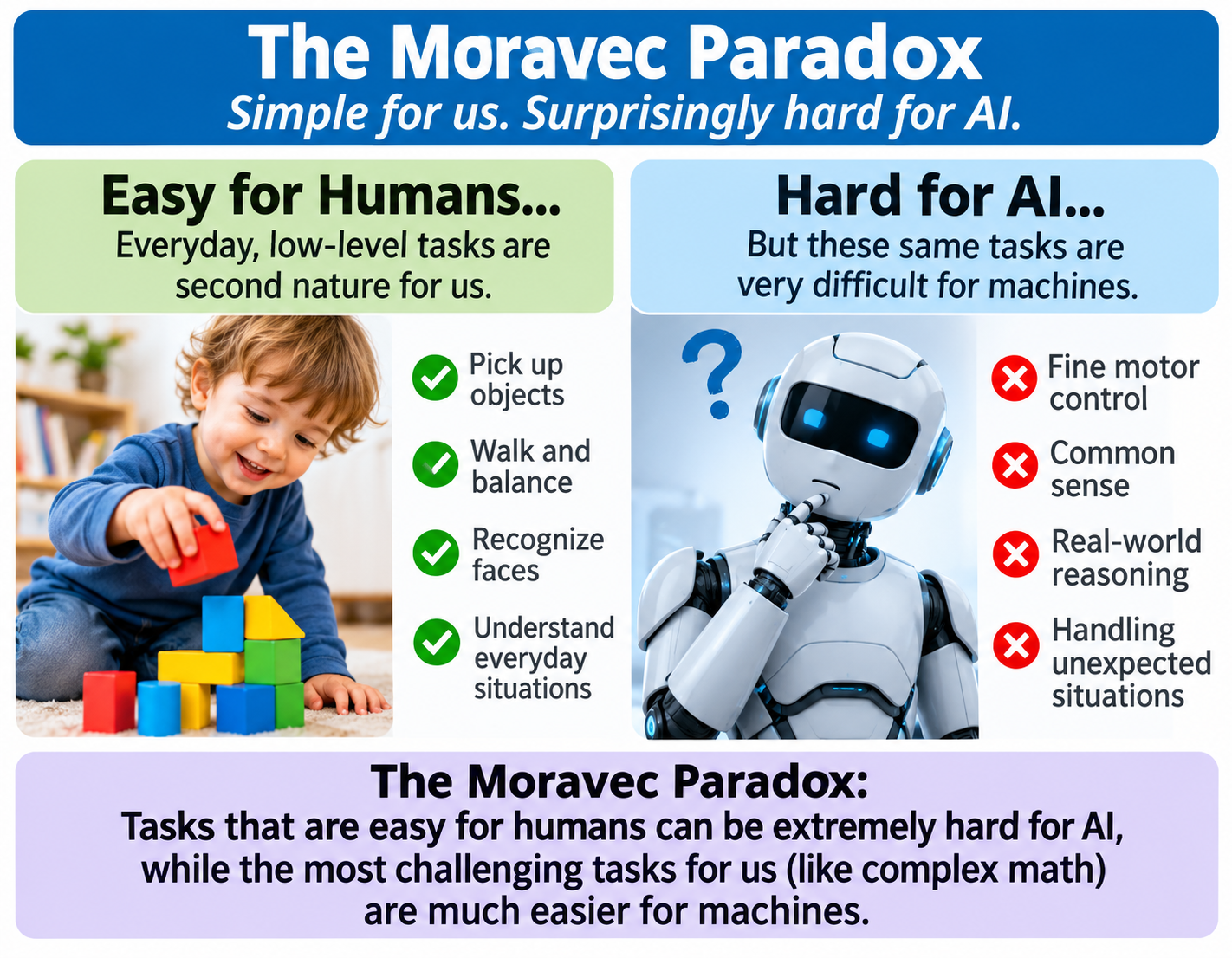
The Moravec Paradox describes a counterintuitive characteristic of artificial intelligence: tasks that are difficult for humans, such as mathematical reasoning, chess, and complex calculations, can be relatively easy for computers, while tasks that humans perform effortlessly, such as recognizing objects, navigating physical environments, understanding social cues, and coordinating movement, remain extraordinarily difficult for machines. First articulated in the 1980s by robotics researcher Hans Moravec and other AI pioneers, the paradox reflects an important distinction between human intelligence and computational ability. Skills that appear simple to us are often the products of millions of years of evolutionary development and involve enormous amounts of unconscious processing.
"In general, we're least aware of what our minds do best. We're more aware of simple processes that don't work well than of complex ones that work flawlessly."
This paradox has important implications for the future development of AI, particularly large language models (LLMs). Modern LLMs can produce sophisticated written arguments, summarize scientific research, generate computer code, and perform increasingly complex reasoning tasks. Yet their apparent intelligence can conceal significant limitations. They do not experience the physical world as humans do, possess ordinary human sensory understanding, or necessarily develop a reliable internal model of cause and effect. Their ability to generate convincing explanations does not guarantee that they understand the underlying concepts or that their conclusions are correct. Integrating LLMs with robotics, visual perception, physical sensors, and real-world interaction may help address some of these limitations, but doing so presents substantial technical challenges.
The paradox also challenges assumptions about how quickly AI will progress toward human-level intelligence. Future development may depend less on simply making LLMs larger and more computationally powerful and more on combining language models with other capabilities, including spatial reasoning, perception, memory, physical interaction, and the ability to learn from experience. Multimodal AI and robotics research are already exploring these possibilities. However, improvements in language processing should not automatically be interpreted as equivalent improvements in general intelligence. AI capabilities remain uneven, and performance in one domain does not necessarily predict competence in another.
From an anti-science perspective, Moravec's Paradox carries an additional lesson: impressive technological demonstrations are easily mistaken for genuine understanding. AI systems can write convincing scientific explanations and polished research summaries while misreading evidence, fabricating references, or repeating misinformation. That polish can give unsupported claims a false appearance of scientific legitimacy, as the fabricated citations in the 2025 MAHA report showed. At the same time, dismissing AI outright because it makes basic mistakes is also misleading, since it ignores the tasks AI performs well. The paradox reinforces the importance of judging capabilities by evidence rather than appearances, recognizing limitations, and keeping humans in the loop. It also counsels caution toward industry claims that increasingly fluent language models are approaching human-level intelligence. The central lesson is that impressive performance is not proof of understanding. When AI-generated errors circulate under the banner of science, they risk eroding trust in the expertise that sound evidence depends on.