Fact Checking Artificial Intelligence

Date: 2026-04-07
Category: Artificial Intelligence
Introduction
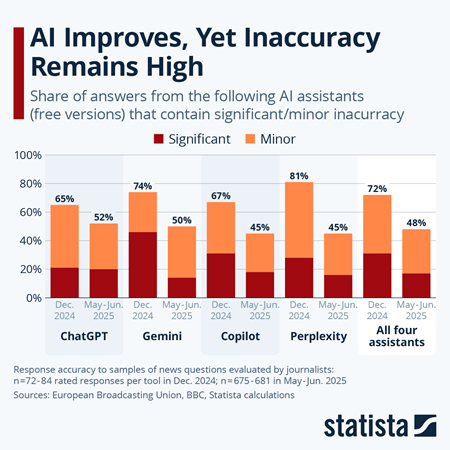
When you ask an AI assistant a question - whether it's about history, science, or how to fix a stubborn piece of code - the first step is to pause before accepting the answer. AI excels at fluency, and fluency can be disarming. A paragraph that reads smoothly can feel true even when it isn't. So the discipline begins with slowing down and asking: What claims is the AI actually making? Extract the concrete statements from the prose. Dates, names, causal relationships, statistics - these are the pieces most likely to drift.
"Forget artificial intelligence – in the brave new world of big data, it's artificial idiocy we should be looking out for."
Once you've identified the claims, the next move is triangulation. Check the information against at least two independent, reputable sources. For factual topics, that might mean cross-referencing encyclopedias, academic institutions, government data, or well-established news organizations. For technical topics, look for primary documentation: official API docs, published standards, or source code. If the AI cites a study, verify that the study exists, that the authors and publication venue match, and that the conclusions are represented accurately. AI systems sometimes fabricate citations that look plausible but lead nowhere.
Context matters as much as correctness. AI answers can be technically accurate but misleading if they omit key constraints or present fringe interpretations as mainstream. A good fact-checker asks: Is this the whole story? Is this the consensus view? Is this claim still current? This is especially important for fast-moving fields like medicine, climate science, or technology, where information can become outdated quickly.
Another essential technique is to probe the assistant with follow-up questions. Ask it to show its reasoning, list its sources, or restate the answer in a more structured form. Inconsistencies often surface when the model is forced to explain itself. If the assistant gives two different answers to the same question, that's a signal to rely more heavily on external verification
Finally, maintain a healthy awareness of your own cognitive biases. AI can mirror your assumptions, reinforce your expectations, or present information in a tone that aligns with what you hope is true. Fact-checking requires stepping outside that comfort zone. The goal isn't to catch the AI in a mistake - it's to ensure that your understanding is anchored in evidence rather than eloquence.
In the end, fact-checking an AI assistant is less about mistrust and more about partnership. The AI provides speed, breadth, and synthesis; you provide judgment, skepticism, and context. Together, the two of you can reach a level of clarity neither could achieve alone.