History of Vaccines

Date: 2026-02-02
Category: Vaccines
All images are AI generated or shared
under Creative Commons licencing complying with rules for Attribution, Non-Commercial, No Derivatives, and Share Alike.
Image Link
Wikipedia Commons
Creative Commons Attribution 4.0 International license.
2017
Introduction
For most of human history, infectious diseases shaped societies with devastating force. Long before modern science understood microbes, people searched for ways to protect themselves. As early as the 15th century - and possibly much earlier - communities in Asia, Africa, and the Middle East practiced variolation, a method of intentionally exposing healthy individuals to smallpox material to induce a milder infection and future immunity. These early attempts were risky, but they represented a profound insight: controlled exposure could prevent severe disease.
"Misinformation or distrust of vaccines can be like a contagion that can spread as fast as measles."
Variolation spread slowly across continents. By the 1600s it was practiced in the Ottoman Empire, where European observers encountered it firsthand. In 1721, Lady Mary Wortley Montagu, having witnessed the procedure in Turkey, introduced it to Britain by having her children inoculated. Around the same time in Boston, an enslaved man named Onesimus described the technique to Reverend Cotton Mather, helping spark its adoption during a deadly smallpox outbreak. These cross-cultural exchanges laid the groundwork for a revolution in disease prevention.
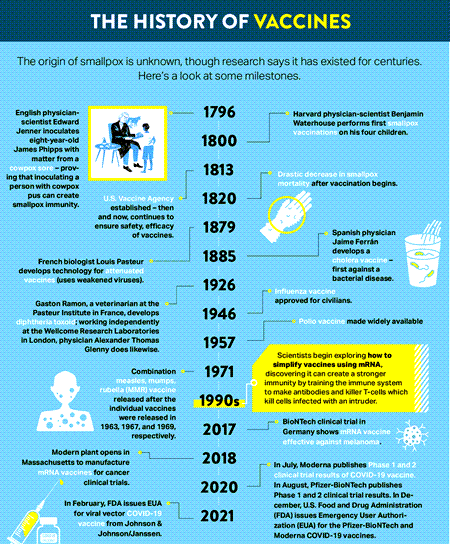
The turning point came in 1796, when English physician Edward Jenner tested a hypothesis circulating among rural communities: milkmaids who contracted cowpox seemed immune to smallpox. Jenner inoculated eight-year-old James Phipps with material from a cowpox sore, and later exposed him to smallpox. The boy did not fall ill. Jenner's experiment - ethically unacceptable by today's standards - became the foundation of the first true vaccine, named from vacca, the Latin word for cow. This breakthrough marked the beginning of immunization as a scientific discipline.
The 19th century brought rapid advances. Louis Pasteur, building on germ theory, developed the first laboratory-created vaccines, including those for fowl cholera and rabies. His work demonstrated that weakened or altered pathogens could safely stimulate immunity, opening the door to vaccines for many diseases. By the early 20th century, vaccines for diphtheria, tetanus, and pertussis were transforming childhood survival.
The modern era of vaccination accelerated after World War II, with global campaigns targeting polio, measles, and other childhood illnesses. The impact has been extraordinary: between the 1970s and 2020s, vaccination efforts helped reduce infant mortality by 40% and prevented an estimated 154 million deaths worldwide.
Recent development include mRNA vaccines that uses a copy of a molecule called messenger RNA to produce an immune response. They offer the potential for personalized cancer and targeted disease treatment. Today, vaccines protect against more than 25 diseases, from influenza to COVID-19. Their development continues to raise scientific, ethical, and societal questions, but their legacy is clear: vaccines have saved more human lives than any other medical intervention in history.