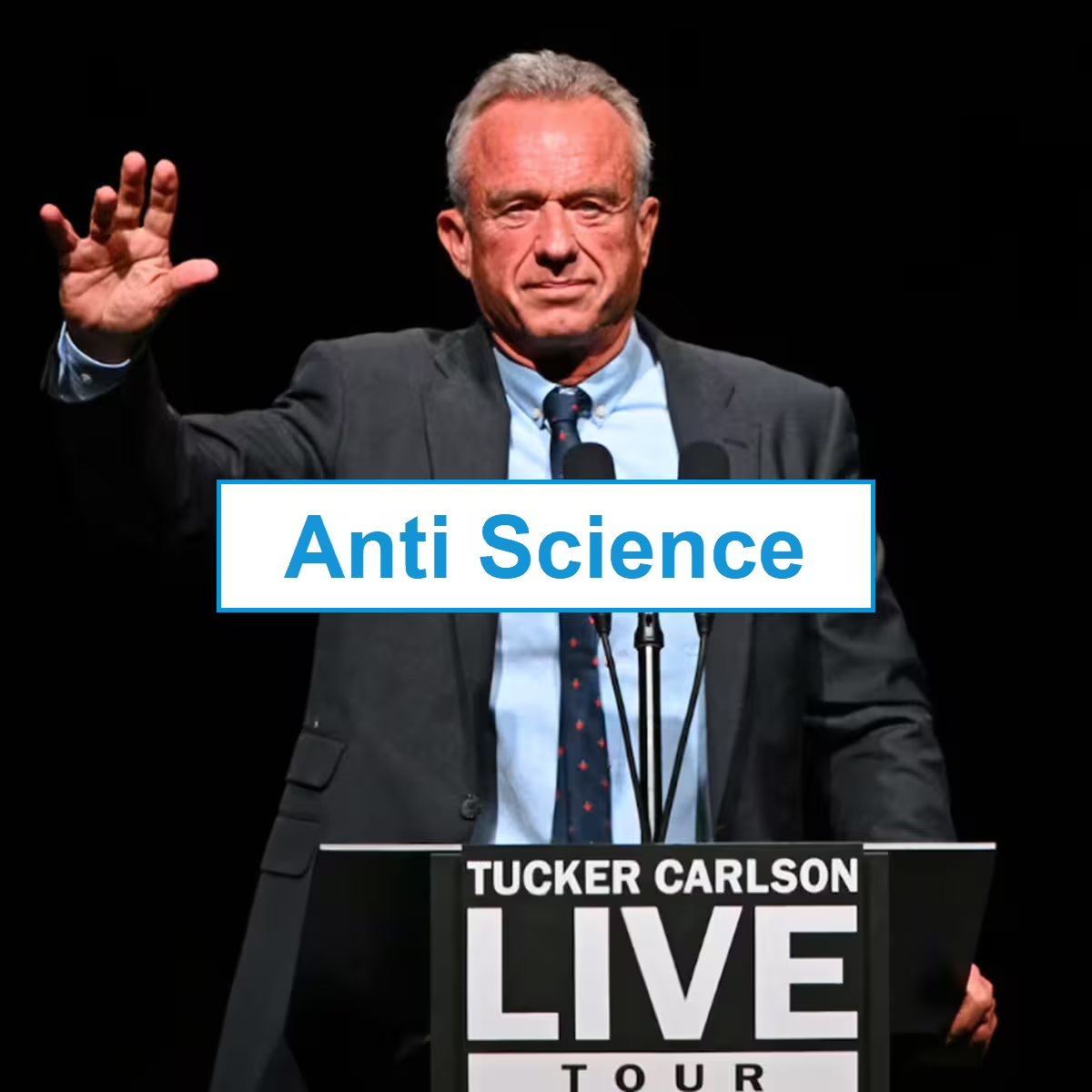
Subject Matter Expertise Matters

Date: 2026-05-18
Category: Science General

Introduction
JD Vance, participating in a public chat at a "Make America Healthy Again" event, argued that it's wrong to "silence" those who push back against the scientific canon. His statement "Science as practiced in its best form is that if you disagree with it, then you ought to criticize it and you ought to argue against it" fundamentally misrepresents how science actually works. In doing so, it drifts into anti-science rhetoric - not because it values criticism, but because it misunderstands what makes criticism meaningful and productive.
"Science as practiced in its best form is that if you disagree with it, then you ought to criticize it and you ought to argue against it."
It is certainly true that criticism lies at the heart of scientific progress. Scientific theories are not sacred; they are constantly tested, refined, and sometimes discarded. Philosophers such as Karl Popper argued that scientific claims must be open to falsification - that they must be structured so they can, in principle, be proven wrong. In this sense, disagreement is not only tolerated but essential. However, the statement in question makes a crucial error: it assumes that all disagreement is equally valid within science. That assumption ignores the standards and expertise that distinguish scientific critique from mere opinion.
In practice, scientific disagreement is not a free-for-all. It is governed by norms of evidence, methodological rigor, and peer evaluation. Peer review, for instance, functions as a structured system of expert judgment, where specialists assess whether claims are supported by reliable methods and data. Criticism in this context requires deep familiarity with the field?its methods, prior literature, and standards of proof. Without this foundation, disagreement does not meaningfully contribute to scientific knowledge.
This is where qualifications become critically important. In science, not all voices carry the same epistemic weight - not because of elitism, but because expertise matters for evaluating complex evidence. A physicist's critique of a physics model, or an epidemiologist's analysis of clinical data, is informed by years of training and engagement with established methods. By contrast, an untrained individual "arguing against" a scientific consensus without understanding its evidentiary basis is not engaging in science, but in commentary. The distinction is not about silencing dissent; it is about recognizing that scientific claims must be assessed by those equipped to evaluate them rigorously.
The claim that it is wrong to "silence" dissent further oversimplifies how science operates. Scientific communities do not arbitrarily suppress disagreement. On the contrary, dissent is built into the system through peer review, replication, and ongoing debate. Disagreements among experts help uncover flawed assumptions, refine methods, and generate new hypotheses. But this dissent is productive precisely because it is informed and accountable to evidence. When disagreement lacks that grounding, it does not advance understanding - it can instead distort public perception.
Indeed, research shows that poorly grounded dissent can be used to exaggerate uncertainty about well-established findings, giving the impression that there is controversy where there is broad consensus. This tactic often relies on elevating unqualified or fringe voices to the same level as domain experts, blurring the distinction between credible critique and unsupported assertion. In such cases, the rhetoric of "open debate" becomes a vehicle for undermining scientific literacy rather than strengthening it.
Ultimately, the statement is anti-scientific not because it defends criticism, but because it detaches criticism from the very conditions that make it scientific: evidence, methodological rigor, and qualified expertise. Science does not treat all disagreement as equal; it evaluates claims based on how well they are supported and who is capable of assessing them. By suggesting that science should simply welcome all opposition without regard for these criteria, the comment erodes the standards that allow science to function as a reliable system of knowledge in the first place.