
The 97% Scientific Consensus on Climate Change

Date: November 07, 2026
Category: Climate Change
All images are AI generated or shared
under Creative Commons licencing complying with rules for Attribution, Non-Commercial, No Derivatives, and Share Alike.
Image Link
AI-generated.
2026
Introduction
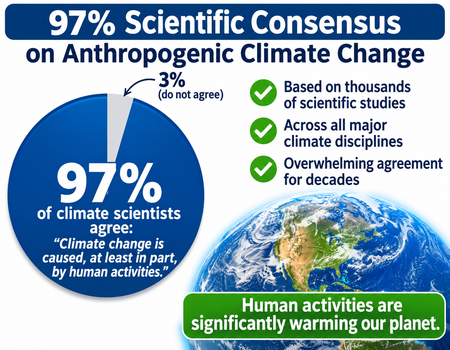
The scientific consensus on climate change is one of the most thoroughly examined findings in modern science. Perhaps its most widely recognized expression is the often-quoted statement that approximately 97% of climate scientists agree that human activities are causing global warming. This figure is strongly associated with Australian researcher John Cook and colleagues, whose landmark 2013 study, Quantifying the Consensus on Anthropogenic Global Warming, provided a systematic measurement of scientific agreement.
"Among abstracts expressing a position on AGW [Anthropogenic Global Warming], 97.1% endorsed the consensus position that humans are causing global warming."
Cook's research examined 11,944 peer-reviewed scientific papers published between 1991 and 2011. Researchers evaluated the papers' abstracts, classifying them according to whether they endorsed, rejected, or expressed no position on human-caused global warming. Of the papers expressing a position, 97.1% supported the conclusion that human activities contribute to global warming. Importantly, this does not mean that 97% of scientists agree on every aspect of climate change. It measures agreement on its central cause: human influence.
The reliability of this finding has been reinforced by subsequent research. A 2016 study by Cook and colleagues examined six independent assessments and found agreement levels ranging from 90% to 100%. In 2021, Mark Lynas and colleagues examined nearly 90,000 climate-related publications and found that agreement exceeded 99% among papers expressing a position on human-caused climate change.
Critics frequently argue that climate science is not settled. In one sense, they are correct: science is never permanently settled, and researchers continue investigating climate sensitivity, regional weather patterns, ocean circulation, and the precise consequences of future warming. Climate models also contain uncertainties, while future outcomes depend partly on human emissions decisions. However, these uncertainties concern the details, magnitude, and timing of climate change, not its fundamental cause. The IPCC describes human influence on the warming of the atmosphere, oceans, and land as unequivocal.
The distinction is important. Scientific uncertainty does not mean scientific ignorance, nor does it invalidate conclusions supported by overwhelming evidence. Demanding absolute certainty before accepting established findings creates an impossible standard that can be exploited to undermine public understanding.
The 97% figure is therefore not simply a slogan. It is a defensible measurement of scientific agreement, supported by independent research. Debate continues over climate projections and solutions, but the fundamental conclusion that human activities are warming the planet is exceptionally well established.