Anti-Intellectualism

Date: 2026-04-16
Category: Science Education
Introduction
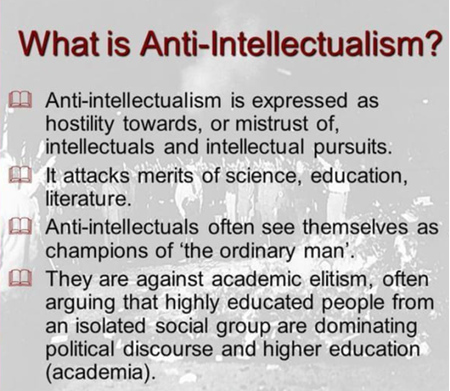
Anti-intellectualism is a mindset or cultural attitude that distrusts, dismisses, or devalues intellectual expertise, critical thinking, and the pursuit of knowledge. It often manifests as skepticism toward scholars, scientists, educators, and professionals, driven by the belief that specialized knowledge is elitist, impractical, or disconnected from "common sense". Rather than engaging with evidence or reasoned argument, anti-intellectualism elevates intuition, emotion, or personal experience to the highest authority. While questioning authority can be healthy in a democratic society, anti-intellectualism becomes dangerous when it rejects the very tools - reason, evidence, and expertise - that allow societies to solve complex problems.
"I’m tired of ignorance held up as inspiration, where vicious anti-intellectualism is considered a positive trait, and where uninformed opinion is displayed as fact."
At its core, anti-intellectualism simplifies a complex world by framing knowledge as something suspect or unnecessary. It can emerge from frustration, insecurity, or historical mistrust of institutions, and it is often reinforced by populist narratives that portray experts as "out of touch" or "self-serving". In this climate, expertise is reframed as arrogance, and learning is viewed as a threat to identity or tradition. Over time, this attitude discourages curiosity and replaces informed debate with slogans, anecdotes, or misinformation.
The risks created by anti-intellectualism are profound and far-reaching. One of the most immediate dangers is the erosion of sound decision-making. Modern societies rely on specialized knowledge to manage public health, environmental policy, infrastructure, and economic systems. When expertise is ignored or mocked, policies are more likely to be shaped by ideology or fear rather than evidence. This can lead to ineffective or harmful outcomes, from the rejection of medical guidance to the mismanagement of scientific and technological resources.
Anti-intellectualism also weakens democratic institutions. A functioning democracy depends on an informed public capable of evaluating arguments, discerning credible sources, and holding leaders accountable. When critical thinking is undervalued, citizens become more vulnerable to manipulation, conspiracy theories, and deliberate disinformation. Public discourse shifts away from reasoned disagreement and toward polarization, making collective problem-solving increasingly difficult. In such an environment, truth becomes negotiable, and expertise loses its capacity to guide public judgment.
In education, the consequences are especially damaging. Anti-intellectual cultures discourage students from valuing learning for its own sake, reducing education to mere credentialing or dismissing it as irrelevant. This undermines long-term innovation, as fewer people are equipped or motivated to engage deeply with research, analysis, and creative problem-solving. Societies that fail to nurture intellectual curiosity risk stagnation, falling behind in scientific, technological, and cultural development.
Finally, anti-intellectualism carries a moral and social cost. It promotes the false equivalence between opinion and knowledge, suggesting that all viewpoints are equally valid regardless of evidence. While pluralism is essential, equating ignorance with understanding erodes standards of truth and accountability. Over time, this diminishes intellectual humility - the recognition that learning is ongoing and that expertise is earned through study and experience.
In sum, anti-intellectualism is not merely a personal attitude but a societal risk. By undermining trust in knowledge and reason, it weakens the foundations upon which progress, democracy, and shared understanding depend. Addressing it requires more than defending experts; it demands a renewed cultural commitment to education, critical thinking, and the idea that knowledge, while imperfect, remains one of the most powerful tools humanity has for navigating an increasingly complex world.