Books Worth A Read

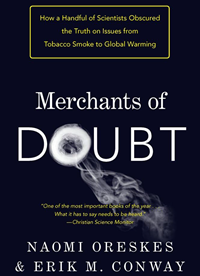
Merchants of Doubt Naomi Oreskes & Erik M. Conway Published: 2010 ISBN-13: 978-1608193943 Science Misinformation Merchants of Doubt unfolds like an investigative journey into the machinery of manufactured uncertainty. The narrative follows a small but influential group of scientists who, despite their credentials, repeatedly cast doubt on well-established research - from the dangers of tobacco smoke to the reality of climate change. Oreskes reveals how these figures leveraged their authority not to advance scientific understanding, but to stall it, aligning themselves with political and corporate interests that benefited from public confusion. What makes the story compelling is the way it exposes doubt as a deliberate product, engineered with the same precision as any commodity. Press releases, think-tank reports, and media appearances become tools in a broader strategy to frame consensus as controversy. Oreskes shows how this tactic exploits a core value of science - healthy skepticism - and twists it into a weapon against the very idea of evidence‑based decision-making. The narrative ultimately becomes a reflection on the fragility of public trust. It illustrates how easily misinformation can seep into civic life when expertise is undermined and uncertainty is sold as truth. Rather than a simple exposé, the book reads as a call to recognize the societal stakes of scientific integrity and the responsibility we all share in defending it. | |
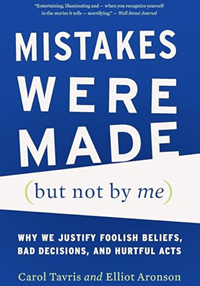
Mistakes Were Made (but Not by Me) Elliot Aronson and Carol Tavris Published: 2015 ISBN-13: 9780547416038 Science Education Self-justification is the quiet force shaping far more of human behavior than most people realize. Mistakes Were Made (But Not by Me) follows this force from the moment a person makes a small, questionable choice to the point where that choice hardens into a confident belief. The authors show how cognitive dissonance - our discomfort with being wrong - pushes us to rewrite memories, reinterpret events, and defend decisions long after evidence has shifted. What begins as a minor rationalization can become a full narrative about who we are. The book moves through intimate relationships, professional settings, and public institutions to reveal how these psychological mechanisms scale. Couples escalate conflicts because each partner clings to a self-protective story. Police and therapists double down on flawed judgments to preserve professional identity. Entire organizations drift into wrongdoing because no one wants to admit the first misstep. The result is a world where harm often grows not from malice but from the human need to see ourselves as competent and moral. Yet the authors argue that awareness is liberating. When people recognize how self-justification works, they can interrupt the cycle - apologize sooner, correct errors faster, and build institutions that value truth over ego. The book ultimately offers a hopeful case for humility as a path to better relationships and better societies. | |
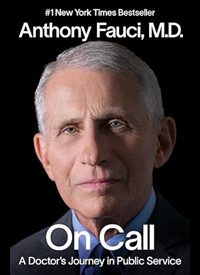
On Call: A Doctor's Journey in Public Service Anthony Fauci M.D. Published: 2024 ISBN-13: 978-0593657478 Vaccines Anthony Fauci's On Call: A Doctor's Journey in Public Service traces his evolution from a Brooklyn childhood shaped by Italian American values of service to a five-decade career at the forefront of U.S. public health. The memoir opens with a defining moment during the COVID-19 pandemic, when news of a successful vaccine trial prompts Fauci to reflect on the arc of his life's work. From his rigorous education at Regis High School and Cornell University Medical College, he develops a deep commitment to patient care, scientific inquiry, and emotional resilience. His early years at the National Institutes of Health mark the beginning of his dual identity as clinician and researcher, preparing him for the crises that would define his career Fauci recounts confronting HIV/AIDS in the 1980s, navigating scientific uncertainty, public fear, and activist demands while pushing for research funding and compassionate care. Subsequent chapters follow his leadership through SARS, Ebola, Zika, and ultimately COVID-19, illustrating the constant tension between science, politics, and public communication. Throughout the narrative, Fauci reflects on the ethical demands of medicine, the rise of misinformation, and the intertwined nature of public health and national security. The book ultimately portrays public service as a lifelong, principled commitment grounded in evidence, empathy, and perseverance. |