Books Worth A Read
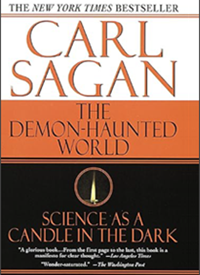
The Demon-Haunted World: Science as a Candle in the Dark Carl Sagan Published: 1995 ISBN-13: 978-0345409461 Antiscience Carl Sagan's The Demon-Haunted World: Science as a Candle in the Dark is a passionate defense of reason at a moment when superstition and pseudoscience threaten to eclipse it. Published in 1995, the book lays out Sagan's mission with clarity: to show that science is not merely a collection of facts but a disciplined way of thinking that helps us navigate a world crowded with seductive falsehoods. Sagan writes with the urgency of someone who sees a civilization drifting toward credulity. He illustrates how conspiracy theories, magical thinking, and untested claims flourish when critical thinking erodes. His famous "dragon in my garage" parable becomes a narrative anchor, demonstrating how unfalsifiable claims can masquerade as truth when shielded from scrutiny. Throughout the book, he argues that skepticism is not cynicism but a necessary tool for distinguishing reality from illusion. Yet the tone is never bleak. Sagan pairs skepticism with wonder, insisting that scientific inquiry deepens our sense of awe rather than diminishing it. He celebrates science as humanity's "built-in error-correcting machine," a method that helps us inch closer to truth even when our perceptions fail us. | |
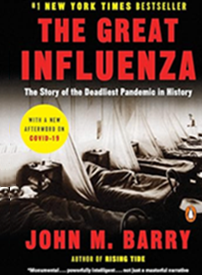
The Great Influenza John M. Barry Published: 2004 ISBN-13: 978-1541705494 Vaccines John Barry's The Great Influenza unfolds with the momentum of a historical thriller, tracing how the 1918 flu pandemic erupted in the United States before sweeping across a world already fractured by war. Barry begins in Haskell County, Kansas, where early cases appeared before moving into Camp Funston, an army training base whose troop movements helped carry the virus across the globe. What followed was a catastrophe of almost unimaginable scale: an infection that reached roughly 500 million people and killed more than 50 million worldwide. Barry's narrative is as much about the evolution of American science as it is about the virus itself. He contrasts the fledgling U.S. medical establishment with Europe's more advanced institutions, showing how the pandemic became the first true collision between modern scientific ambition and an epidemic of staggering lethality. The story's power lies in its human dimension-researchers racing to understand a pathogen that killed faster than they could study it, public officials struggling to maintain trust, and communities overwhelmed by loss. Throughout, Barry argues that truth and transparency are the strongest tools in confronting a pandemic, a lesson he underscores through the failures of 1918 and the moral imperative to face horror honestly. The result is a sweeping, sobering account of science tested under fire. | |
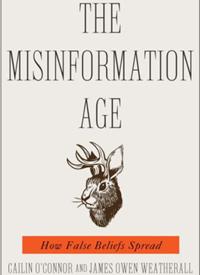
The Misinformation Age: How False Beliefs Spread Cailin O'Connor and James Owen Weatherall Published: 2020 ISBN-13: 9780300251852 Science Misinformation Why should we care about having true beliefs? And why do demonstrably false beliefs persist and spread despite bad, even fatal, consequences for the people who hold them? Philosophers of science Cailin O'Connor and James Weatherall argue that social factors, rather than individual psychology, are what's essential to understanding the spread and persistence of false beliefs. It might seem that there's an obvious reason that true beliefs matter: false beliefs will hurt you. But if that's right, then why is it (apparently) irrelevant to many people whether they believe true things or not? The Misinformation Age, written for a political era riven by "fake news", "alternative facts", and disputes over the validity of everything from climate change to the size of inauguration crowds, shows convincingly that what you believe depends on who you know. If social forces explain the persistence of false belief, we must understand how those forces work in order to fight misinformation effectively. |