Green-Energy Myths Promoted by the Fossil-Fuel Industry

Date: 2026-02-23
Category: Climate Change
Introduction
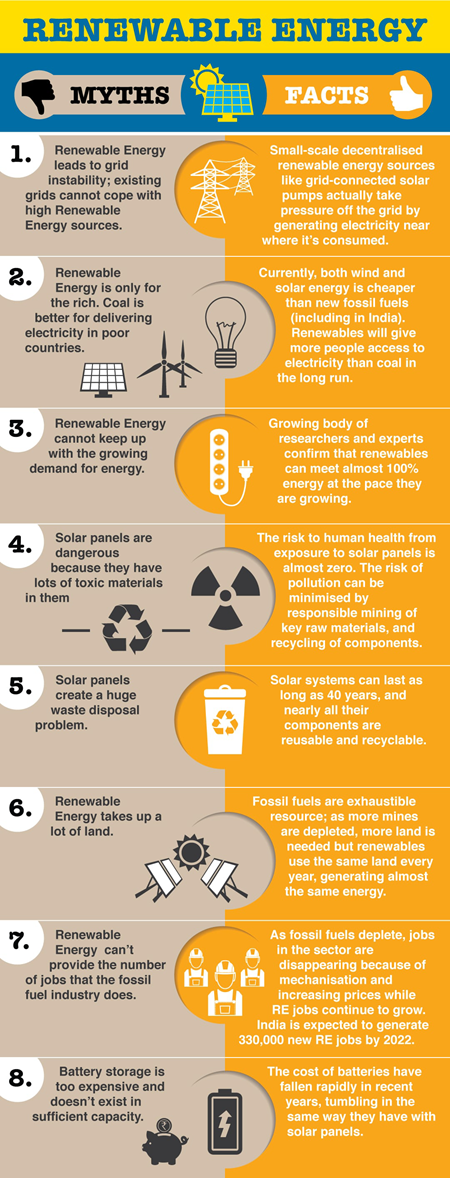
The fossil fuel industry has promoted several myths about green energy to protect their massive, long-term investments in oil and gas infrastructure, and maintain profitability. These myths typically focus on the cost, reliability, and environmental impact of clean energy sources.
"One of the most exciting opportunities created by renewable energy technologies like solar is the ability to help the world's poorest develop faster - but more sustainably too."
Several of the more commonly promoted and circulated green-energy myths are addressed below.
Renewables can't provide reliable baseload power.
Claim: Wind and solar are "too intermittent" to support a modern grid.
Facts:
- Modern grids do not rely on a single "baseload" source; they rely on flexible, diversified portfolios.
- Countries such as Denmark, Portugal, and parts of Germany routinely operate with 50-80% renewable penetration while maintaining reliability
- Grid operators use forecasting, demand response, storage, and geographic diversity to smooth variability
- The U.S. National Renewable Energy Laboratory (NREL) and multiple independent grid studies show that 80-90% renewable grids are technically feasible with existing technologies.
Solar panels take more energy to make than they produce.
Claim: Manufacturing solar panels consumes more energy than the panels will ever generate.
Facts:
- Modern photovoltaic panels repay their manufacturing energy in 1-3 years, depending on location.
- Their operational lifetime is 25-35 years, meaning they produce 10-30 times the energy used to make them.
- This myth originated from outdated 1970s data and continues to circulate despite decades of updated research.
Wind turbines use more electricity than they generate.
Claim: Turbines require constant power input for heating, rotation, and electronics.
Facts:
- Turbines do use small amounts of electricity for internal systems, but this is a tiny fraction of what they generate.
- A typical modern turbine produces hundreds of times more energy than it consumes over its lifetime.
- This myth stems from misinterpreting maintenance logs and has been repeatedly debunked by grid operators.
Electric vehicles pollute more than gasoline cars.
Claim: EVs are worse for the environment because of battery manufacturing and electricity sources.
Facts:
- Every major lifecycle analysis (IEA, EPA, EU, NREL) shows EVs produce significantly lower lifetime emissions, even when charged on fossil-heavy grids.
- As grids decarbonize, EV emissions drop further.
- Battery recycling and second-life applications continue to expand, reducing long-term impacts.
Renewables are more expensive than fossil fuels.
Claim: Clean energy raises electricity prices and burdens consumers.
Facts:
- Wind and solar are now the cheapest new sources of electricity in most of the world, according to the International Energy Agency and Lazard's Levelized Cost of Energy reports.
- Price spikes in many regions have been driven by volatile fossil-fuel markets, not renewables.
- Long-term contracts for wind and solar often stabilize electricity prices.
Wind and solar require massive subsidies, unlike fossil fuels.
Claim: Renewables only survive because of government support.
Facts:
- Fossil fuels have received decades of subsidies, tax breaks, and infrastructure support - globally amounting to trillions of dollars.
- Renewable subsidies are smaller and more recent, and many are designed to correct market distortions created by fossil-fuel externalities (pollution, health impacts, climate costs).
- In many regions, renewables are cost-competitive even without subsidies.
Renewables destroy wildlife and ecosystems
Claim: Wind turbines "kill all the birds" and solar farms "destroy habitats".
Facts:
- All energy sources have environmental impacts, but wind and solar rank among the lowest-impact per unit of energy produced.
- Bird mortality from turbines is orders of magnitude lower than from buildings, vehicles, and domestic cats.
- Modern siting practices, radar systems, and habitat-mitigation strategies significantly reduce impacts.
- Fossil-fuel extraction causes far greater habitat loss, pollution, and long-term ecological damage.
View this Sabin Center for Climate Change Law link for additional green-energy myths.