Solar Energy Storage and Options for the Future

Date: 2026-02-23
Category: Climate Change
Introduction
By the time the sun slipped behind the ridge, the valley was still glowing - not from daylight, but from the quiet choreography of storage systems humming to life. Lila stood on her porch and watched the transition happen almost imperceptibly. The panels on her roof had spent the day gathering photons, but the real magic was in how the community held onto them.
"I have no doubt that we will be successful in harnessing the sun's energy. ... If sunbeams were weapons of war, we would have had solar energy centuries ago."
Her own home battery was the familiar kind - lithium-ion, compact, reliable, the workhorse of the early clean-energy era. But the town had grown beyond that. Down the road, the agricultural co-op had installed sodium-ion batteries, cheaper and built from abundant materials. They didn't store quite as much energy, but they were rugged and perfect for farms that needed steady, predictable power.
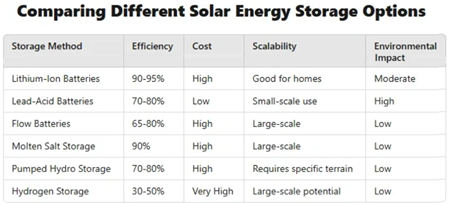
Further out, the old industrial park had been reborn as an energy-storage district. Massive tanks of vanadium flow batteries sat like quiet sentinels, their liquid electrolytes circulating in slow loops. They weren't flashy, but they could store energy for hours without wearing out - a kind of long-distance runner in a world full of sprinters. Next to them, a pilot project was testing zinc-air batteries, which promised multi-day storage using materials that could be sourced locally. Lila liked to think of them as the "rainy-week batteries", the ones that would carry the town through stretches of cloudy weather.
And then there were the experiments that felt almost like science fiction. On the hillside, a gravity-storage system used surplus solar power to lift heavy blocks during the day, then lowered them at night to generate electricity. It was simple physics, but elegant - sunlight turned into potential energy, waiting patiently for darkness. Beneath the town, engineers were exploring thermal storage: vats of molten salts and insulated stones that held heat for days, ready to be converted back into electricity or used directly for heating.
Even hydrogen had found a place in the mix. A small electrolyzer near the reservoir split water into hydrogen during sunny afternoons, storing it for seasonal use. It wasn't perfect yet - efficiency still had a long way to go - but it offered something no battery could: the ability to bank summer sunlight for winter nights.
Lila loved the diversity of it all. Solar energy had once been dismissed as intermittent, but now it felt like the most dependable part of the grid. Not because the sun had changed, but because people had learned to catch its rhythm - short-term storage for homes, medium-duration systems for neighborhoods, long-duration and seasonal storage for the whole region. Each piece played a role, like instruments in an orchestra.
As the first stars appeared, the lights in the valley stayed steady, powered by sunlight captured hours, days, even months earlier. Lila felt a quiet pride. The future wasn't just about generating clean energy; it was about learning to hold it, shape it, and share it in ways that made communities stronger. And tonight, the future felt very close.