Atlantic Meridional Overturning Circulation (AMOC)

Date: 2026-02-01
Category: Climate Change
Introduction
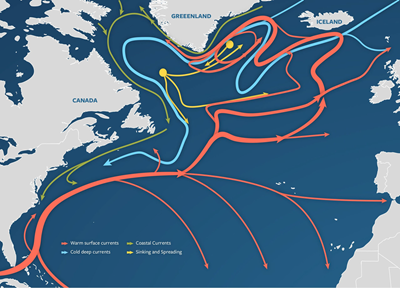
For thousands of years, the Atlantic Meridional Overturning Circulation (AMOC) has moved like a hidden engine beneath the ocean's surface - steady, powerful, and largely unnoticed. This vast conveyor belt of water carries warm, salty currents northward from the tropics, where they release heat into the atmosphere and help keep Europe's climate unusually mild for its latitude. After cooling, the waters sink and flow back southward at depth, completing a cycle that shapes weather patterns, sea levels, and even the distribution of marine life. It is one of Earth's great stabilizing forces, a planetary heartbeat pulsing quietly in the deep.
"We estimate a collapse of the AMOC to occur around mid-century under the current scenario of future emissions."
But in the last century, that heartbeat has begun to falter. As human-driven climate change warms the planet, glaciers and ice sheets melt, pouring fresh water into the North Atlantic. Fresh water is lighter and less salty, making it harder for surface waters to sink - an essential step in the AMOC's circulation. Scientists have detected signs of weakening, subtle but unmistakable, like the early tremors before a larger shift. The concern is not that the AMOC will suddenly stop tomorrow, but that continued warming could push it toward a tipping point where the system reorganizes abruptly, with consequences that ripple across the globe.
The impacts of a weakened AMOC would not be evenly distributed. Northern Europe could face harsher winters and more volatile weather. The tropics might see intensified heat and disrupted rainfall patterns, threatening agriculture and water supplies. Sea levels along the eastern coast of North America could rise faster than global averages as ocean currents redistribute mass. Even ecosystems far from the Atlantic would feel the effects, as changes in ocean circulation alter nutrient flows and marine habitats. The AMOC is not just an oceanographic curiosity - it is a climate regulator woven into the fabric of human and ecological stability.
Yet the story is not only one of risk; it is also a reminder of how interconnected our systems truly are. The AMOC responds to the cumulative choices societies make about energy, land use, and emissions. Its vulnerability underscores a broader truth: climate change is not a distant abstraction but a force capable of reshaping the very mechanisms that make our world habitable. Understanding the AMOC's role helps illuminate the stakes of our moment. It invites us to see the ocean not as a passive backdrop but as an active participant in the climate story - one whose rhythms we disrupt at our peril.