


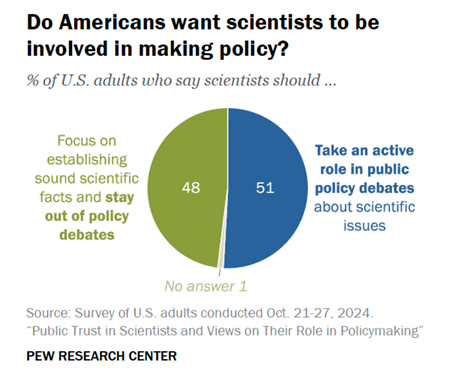
Overall U.S. trust in science increased slightly, from 76% of those surveyed in 2024 to 77% in 2025, according to the Pew Research Center's annual survey. Scientists ranked as the most trusted profession among all groups Pew asked about. Yet the headline number conceals meaningful turbulence beneath the surface.
"Engaging with society isn’t a betrayal of science; it’s a fundamental part of its purpose, especially in complex crises like those we face today."
Pre-pandemic data from January 2019 showed that 86% of Americans had a great deal or fair amount of confidence in scientists, with just 13% expressing little or no confidence. Editage Insights The high point for public trust came in 2020, when 87% had confidence in scientists - a figure that has not recovered. The Lancet In short, today's "improved" numbers remain well below the baseline from just six years ago.
The Pandemic Turning Point
As the pandemic continued, public confidence declined steadily. By December 2021 and September 2022, just 77% of U.S. adults expressed a great deal or fair amount of trust in scientists - a 7-point drop from April 2020. The share of Americans who say science has had a mostly positive impact on society fell 16 percentage points since before the pandemic, from 73% in January 2019 to 57% in 2023.
The Partisan Divide
The most striking feature of the data is not the overall number - it is the widening gap between political groups. A larger majority of Democrats than Republicans express confidence in scientists to act in the public's best interests (88% vs. 66%). Pew Research Center The number of Republicans who don't trust that scientists act in the public's best interest more than doubled, from 14% in April 2020 to 38% in 2023. The Elm In 2016, 76% of Americans reported no strong opinions on their trust in science. By 2020, that figure plunged to 29% - the neutral middle effectively collapsed.
A Global Perspective
A 68-country survey of 71,922 adults found that public trust in scientists was "moderately high" - scoring 3.62 on a scale of 1 to 5. Crucially, no country scored "very low." Some 57% of those surveyed believed that most scientists are honest, and 75% agreed that the scientific method is the best way to test a hypothesis. The United States ranked 12th globally in public trust in scientists.
How the Public Sees Scientists
Encouragingly, 89% of the U.S. public viewed scientists as intelligent, 65% thought they were honest, and 65% believed they were working to solve real-world problems. However, perception gaps are significant: about one-third of U.S. adults view scientists as neglecting societal moral values (36%) or as "cold" (34%), and 28% described scientists as closed-minded. Only 45% of U.S. adults thought that scientists were good communicators - nine points lower than in 2019.
A Sharp Recent Drop
In June 2025, only 8% of U.S. adults reported a great deal of trust in science - a drop of nearly 24 percentage points from the record of 32% in June 2023. Additionally, over 94% of U.S.-based researchers expressed concerns about the future of science.
The Bottom Line
The data paint a nuanced picture: broad, surface-level trust in science remains intact globally, but it is increasingly hollow - polarized along political lines, weakened by pandemic-era turbulence, and undermined by perceptions that scientists are poor communicators disconnected from public values. The deeper problem may not be outright distrust of scientists, but rather the limited influence of scientific messages on public behavior and belief. Science, in other words, is not the same as being heard.
| • | Trends in US public confidence in science and opportunities for progress |
| • | Trust in scientists and their role in society across 68 countries |
| • | Trust edges up—slightly |